
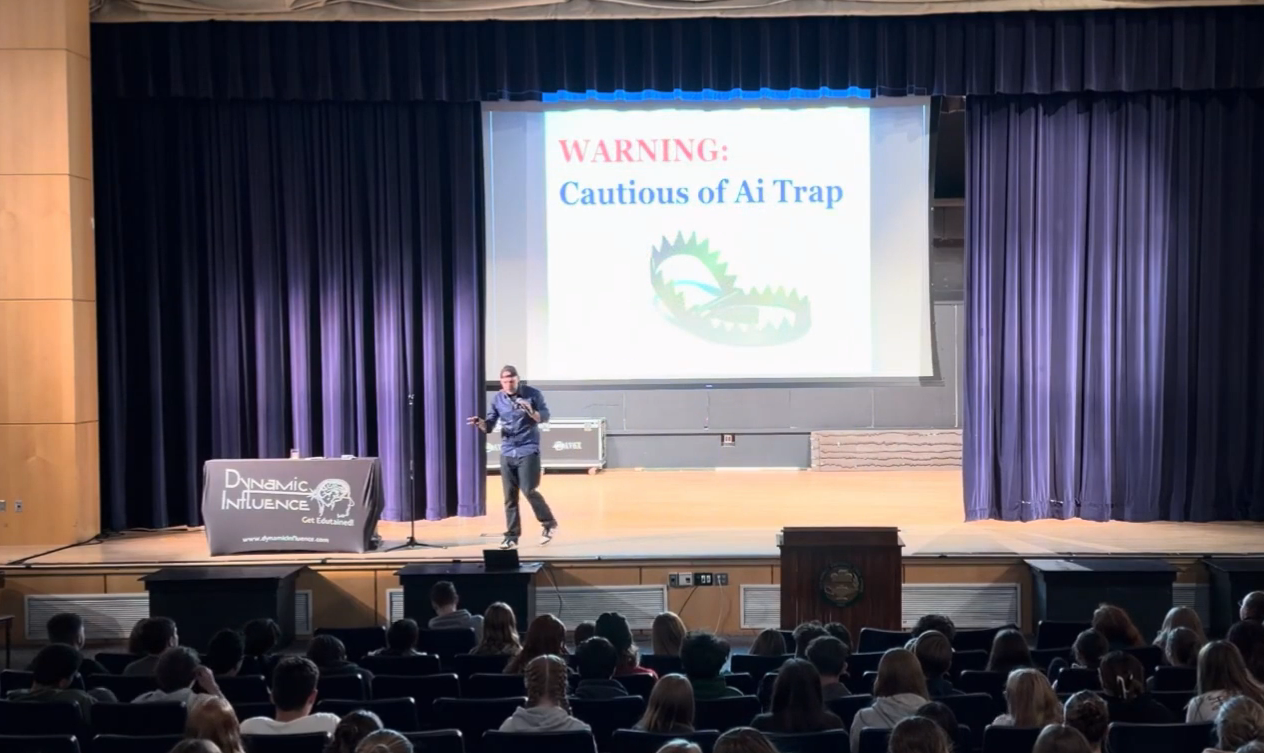
Your teen spent an hour on digital wellness, AI, and the online dangers that don't announce themselves. Watch what they saw, then open any section below for ways to keep the conversation going at home.
The message was never "technology is bad." The real dangers online are hidden — nobody thinks it will happen to them until they step on one.
Use technology — don't let it use you.A friend dying of cancer told the speaker that how he valued his time was what changed most. Two recreational hours of screens a day adds up to a full month a year.
The most valuable thing each of us has is our time.Every like releases dopamine — the brain's "keep doing that" signal. Social media, TikTok and games are designed to bring teens in and keep them there.
Teens know every insecurity they have, but only see everyone else's highlight reel. That's a rigged comparison.
Comparison is the death of joy.An illusion made the speaker's head seem to shrink and grow. With AI and deepfakes, the gap between what's real and what's shown is wider than ever.
Sleep, exercise, and face-to-face time. If screens are replacing any of those three, it's time for a limit.
A chatbot says every idea is brilliant. Real friends don't. Relationships are supposed to be a little awkward — that's how social skills get built.
Learn to have relationships with people, not the AI."You're so stupid" with no tone or face could be a joke or an attack. Calm down, then talk in person or by call — never work out a conflict by text.
Be curious, not judgmental.Online, you can't see when a roast stops being funny. Post about others — and create AI images of others — only the way you'd want it done to you.
Just because you don't physically touch someone doesn't mean they won't feel it.Any chat, Snap or Discord message is one screenshot from forever, and colleges and employers look. Before posting: would I want this about me, on a billboard, forever?
Try one in the car, where nobody has to make eye contact. Prefer paper? Print these as cards.
"Which online 'landmine' do you think kids at Tantasqua step on most?"
Asking about other kids gets more honest answers — and tells you what they're seeing.
"He challenged everyone to track screen time for a week. Want to do it together? I'll track mine too."
Doing yours alongside theirs turns an accusation into a shared experiment.
"What do you actually use AI for? Show me something you've done with it."
Curiosity, not interrogation. If a chatbot is who they talk to when they're down, ask what it gives them that people don't.
"Whose life online looks perfect? What do you think it's really like underneath?"
It's easier for a teen to spot the social mask on someone else first.
"If anyone online ever threatened or pressured you, you would never be in trouble for telling me."
Not a question — a sentence to say out loud before anything happens. Silence is what online blackmail depends on.
2 hrs/day × 365 = 730 hours ≈ 30 days
Two hours a day is a full month a year on a screen; four hours is two months. The speaker's own fix: his phone goes in a basket on the kitchen table when he gets home. The first two weeks are hard — after that it's easy.
Power down at least an hour before bed. Charge the phone outside the bedroom (an alarm clock costs a few dollars), or at minimum across the room. Try it for two weeks — it works best when the whole house does it.
In person is best, then a call or FaceTime. Text is where arguments escalate. Worth modeling yourself.
People online often aren't who they say they are. The growing pattern for high schoolers: someone posing as a peer trades an image to get one back, then threatens to share it unless the teen pays or sends more. That's sextortion.
Students also heard about a 15-year-old who packed a bag to leave with someone she met online. A friend thought it sounded sketchy and told the principal. The man waiting in the parking lot had a warrant for human trafficking.
And once an image of a minor is sent on to anyone else, it's distribution — where police can get involved, even when everyone is a teenager.
There's no single right number. A better test: are screens replacing sleep, exercise, or face-to-face time? If so, limit that. Research shown to students put the happiness break-even point near two recreational hours a day.
Using AI isn't the concern — AI replacing people is. Ask what they use it for and listen. If it's become where they bring their feelings, a gentle conversation (and maybe their school counselor) is worthwhile.
Make it about the scam, not them: "I read about a scam where someone pretends to be a teen and blackmails kids. If that ever happened to you or a friend, you'd never be in trouble for telling me."
Yes, and some pay firms to do it. Nothing is truly private — anything is one screenshot from public.
It's the single highest-return change. It lands best as a household rule, not a punishment.
Start with curiosity, not judgment. Ask them to apply Golden Rule 2.0, then make the repair concrete — including taking content down.
At Tantasqua
Massachusetts
Online exploitation
Screens & family media
These lines are free and staffed 24/7.
Part of another school, parent group, or youth organization? Robert Hackenson Jr. presents nationwide.
Check availabilityPresentation recordings are for family viewing only and may not be redistributed.