
Thank you, Raymond! This week I spent time with students at Iber Holmes Gove Middle School (grades 4–5 and 6–8) and Raymond High School (10th grade), then joined parents for a virtual presentation on Wednesday night. Thank you to every family who carved out the time.
If you couldn't make it, the full recording is below. Tap any topic after the video to open it.
The video is password protected. Enter the code Raymond to watch.
The short version: teach kids to recognize their emotions and have a plan to calm down. In a conflict, the goal is to learn, not to win. If it turns confrontational, walk away. If it's happening to someone else, support that person.
The message was never "be best friends with everyone." That isn't realistic. Kids will click with some people faster than others. The goal is that not clicking with someone doesn't make them an enemy.
I asked students if they'd ever refused a food because it looked gross, then tried it and loved it. People work the same way. When we slap a label on someone, we treat them based on that label and miss out on who they really are. Most kids have had the experience of getting stuck in a group project with someone they'd written off, only to find out that person was actually pretty great.
Everyone's point of view comes from three things: formal education, personal experience, and outside influences (friends, family, social media, advertising). Nobody's mix is the same as ours. So when someone thinks or acts differently, the better question is "Why do they see it that way?"
Kids know the difference between right and wrong. When they don't act on it, emotion is usually the reason. Once a kid decides it's a bad day, the brain goes looking for proof, the frustration builds, and eventually they explode on someone who didn't deserve it. Ways to change the mood:
Try this at home: sit down with your child and write out their own calm-down action plan together. Keep it somewhere they'll see it.
Much of what we mean comes through in tone and body language, and a text carries none of it. That's why so many conflicts start with a misread message. I use a real one: my wife got a text from a coworker that just said "K." Some people would read that as annoyed. She knew it was friendly. The rest of us fill in the tone ourselves, and we usually fill it in wrong.
The rule: if a message upsets you, put the device down and calm down first. Then call, FaceTime, or talk in person. Don't try to work it out over text.
The goal of a debate is to win, which means someone has to lose. The goal of a conversation is to listen and learn. When I asked students whether they'd rather win or learn, the room split almost evenly.
Here's the catch: being wrong doesn't feel bad. Finding out you're wrong feels bad. Until then, being wrong feels exactly like being right. So what else are we sure about that we just haven't found out yet?
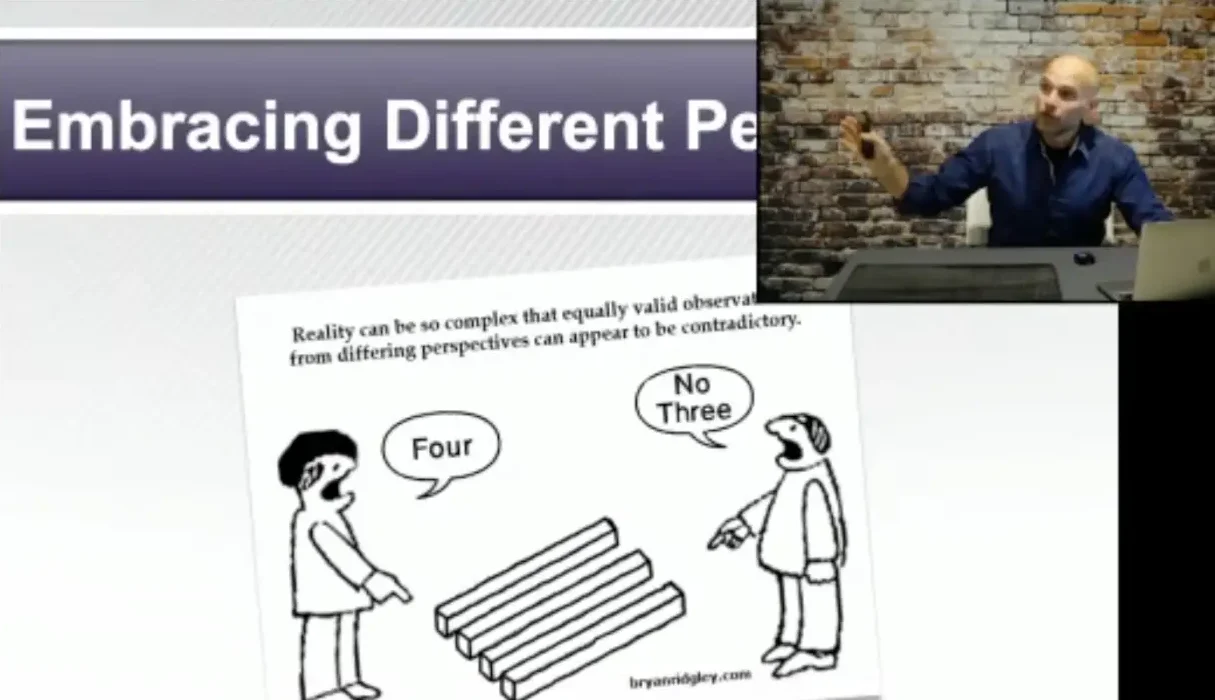
We also argued about the right way to make a peanut butter and jelly sandwich. (Peanut butter on both slices keeps the jelly from soaking through. You're welcome.) And I showed an image where one side sees four objects and the other sees three. When you pull someone toward your view, they pull back. When you go to their side to understand what they see, they become much more willing to come look at yours. Asking questions and really listening is what empathy looks like in practice.
"Bullying" gets used for a lot of things. Everyone has a bad day and snaps at somebody, and that's hurtful, but it isn't bullying. Bullying is:
If it doesn't fit all three, it's probably a one-off. That's still worth talking about, and it's a chance for your child to practice handling it.
It isn't only loners, kids with low self-esteem, or boys, and it isn't "just part of childhood." Girls are very much involved, especially when it comes to rumors and online. Nobody is born a bully. The behavior is learned: from a sibling, from having it done to them, or from saying something mean and getting a laugh. Underneath it is usually insecurity, envy (wanting what someone else has), or jealousy (fear of losing what you have).
Often kids who stand out in some way: appearance, body size, perceived sexual orientation, how masculine or feminine they seem, grades, race or ethnicity, income, or disability. But anyone can be targeted, including the popular kid or the team captain. And anyone can be the one doing it.
Online, bullying looks like hateful posts, rumors, deliberately leaving someone out of group photos, "outing" someone's secrets, fake profiles, pile-ons, and roasting that goes too far. I asked the students how you know when a roast has gone too far in person. "The kid's crying." Online, you can't see that. The screen hides the hurt, so it keeps going.
Everyone wears a social mask, showing the world only what they choose. When kids compare their whole truth (the good and the bad) to someone else's highlight reel, they feel worse. And they have no idea what the person they're targeting is already dealing with.
The Golden Rule 2.0: post about others the way you want people to post about you and the people you care about.
Bullying runs on power, and a reaction is how kids hand that power over. Anyone with a sibling knows this: you know exactly which button to push, and the moment they yell for Mom, you've won. So instead of reacting the way the other kid wants, give the opposite response. Fighting fire with fire just means everyone gets burned. Use a fire extinguisher instead.
"You're bald." "You're totally right. Your hair looks great, though." A shrug, a smile, and a thumbs up: "Yep, you got me." Your child doesn't have to believe it. They're just refusing to value that kid's opinion more than their own.
I've done martial arts for years, and the first line of defense is your legs. The second is your words: "Hey, I didn't mean anything by it, we're good." Physical force is only for real self-defense, when someone has hands on you and you can't leave. Otherwise, a fight turns a name-calling incident into something far worse, and your child ends up in trouble too.
If they need to de-escalate, the rules are: stay calm and don't shout, give the other person space, keep hands visible and stand at an angle instead of squared up, and don't stare them down or point. Then ask questions, acknowledge how they feel, and suggest a way out. People calm down once they feel heard.
Once you report, expect a process. Under New Hampshire law, schools must notify the parents of the students involved within 48 hours of a report and begin an investigation within five school days. The school legally can't tell you how it's disciplining another student, so keep your focus on supporting your own child. Bullying is a relationship problem, and it takes a relationship solution. That doesn't happen overnight.
Bystanders are the most important people in the room. They don't need to confront anyone. They can tell a trusted adult, refuse to laugh along (which takes away the power), and above all, support the kid being targeted. Building someone up is easy, and it doesn't make the bystander a target.
Some of my best conversations with my three kids happen on walks or in the car. In our car, earbuds come out. Sometimes we ride in silence, and that's okay too. The point is to leave the door open.
Skip "How was your day?" You'll get "fine." Ask these three instead:
When they give you a nugget, build on it with "What did you think about that?" Listen, don't judge.
If it feels like nothing you say is getting through, keep saying it. Kids take in far less than we say, so an important message usually has to be repeated many times before it sticks.
If a child is in crisis: call or text 988 (Suicide & Crisis Lifeline), or text HOME to 741741 (Crisis Text Line). If someone is in immediate danger, call 911.
Bullying is unwanted, aggressive behavior with an imbalance of power that happens repeatedly. A single mean comment on a bad day is hurtful but usually isn't bullying.
Give the opposite of the reaction the other kid wants. Agree calmly, add a compliment or a thumbs up, and move on. A reaction is what hands over the power.
No. Walking away is the strongest move. Physical force is only for real self-defense, when your child can't leave and someone has hands on them.
Contact the school when the behavior is repeated, isn't stopping, or is getting worse. In New Hampshire, schools must notify parents within 48 hours of a report and begin investigating within five school days. They can't share how another student is disciplined.
Skip "How was your day?" Ask for one thing they learned, one thing that made them laugh, and one thing that annoyed them, and build on what they say.
We all get it wrong sometimes as parents. But research on resilience keeps finding the same thing: kids who do well despite adversity almost always have at least one stable, committed relationship with a supportive adult (Harvard Center on the Developing Child). That might be you for your child. It might be you for one of your child's friends. The fact that you're reading this tells me you're that person. Thank you.
Engaging, magic-integrated bullying prevention for students, staff, and parents, with no fear tactics.
Check Availability