
Most teens aren’t vaping, drinking or using marijuana. But teens overestimate substance use among their peers, and that gap is where a lot of bad decisions start.
Ask a room of high school students one question: “How many kids in this school vape, drink, or smoke weed?”
You’ll hear “everybody.” Or “like, 90%.” Somebody in the back will say “all the seniors,” and half the room will nod.
Then show them the real numbers, and the room gets quiet.
I’ve watched this happen in a lot of gyms and auditoriums. Students aren’t lying when they say “everybody.” They believe it. And that belief does more damage than most of us realize.
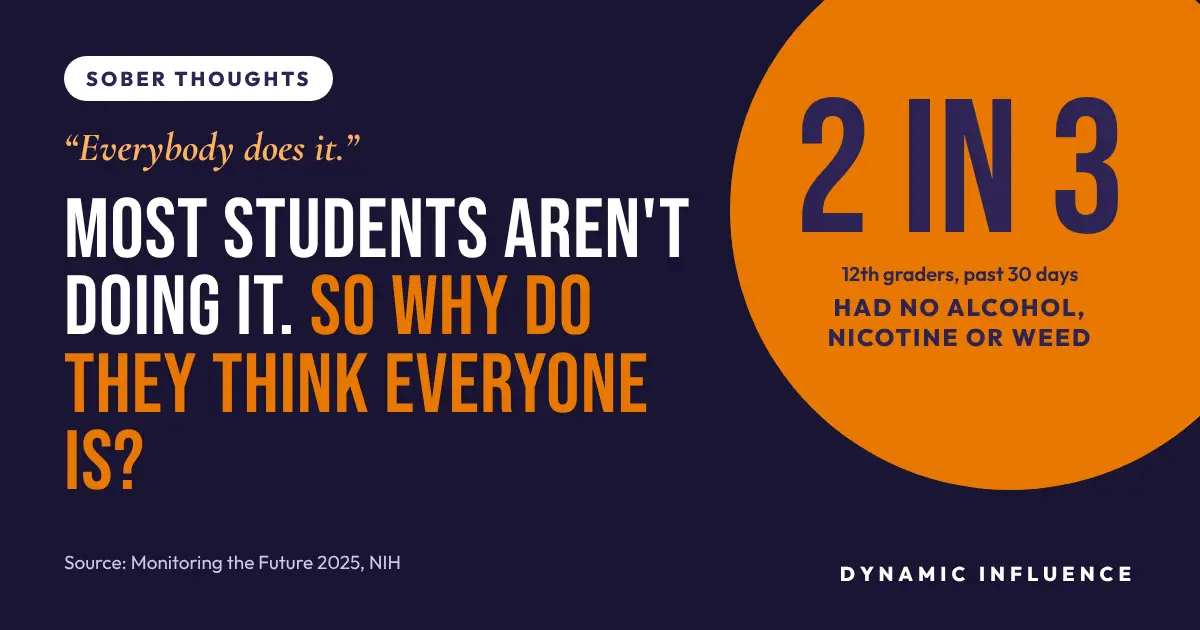
Every year since 1975, the National Institutes of Health has funded a national survey of teens through the Monitoring the Future study. The most recent results (December 2025) looked at students who had not used marijuana, alcohol, or nicotine in the past 30 days:
Even among seniors, two out of three hadn’t used any of the three in the past month. Nicotine vaping, the one everybody “knows” everyone does, came in at 9% of 8th graders, 14% of 10th graders, and 20% of 12th graders over the past year.
That isn’t “everybody.” In most schools, it isn’t even close.
Researchers led by Mitchell Prinstein and Geoffrey Cohen found that teens overestimate substance use among their peers, consistently guessing too high on how much classmates drink, use drugs, and smoke. They also underestimate how much their peers study and exercise.
Then they followed a group of 9th graders through 11th grade. The students who overestimated how much the popular kids were using showed steeper increases in their own cigarette, marijuana, and alcohol use by 11th grade.
Students weren’t only copying what their friends did. They were copying what they thought their friends did.
— Robert Hackenson Jr.When I talk with students about decision making, I start with a simple idea. We make decisions using knowledge, and knowledge comes from three places:
What you learn in school.
What you’ve lived through.
Everything else: friends, family, social media, movies, marketing.
That third one is the loudest. It’s where “everybody does it” lives, and it’s the main reason teens overestimate substance use. A student sees a few classmates vaping in a bathroom, a video of someone they follow, a show where every party has a red cup in every hand. None of that is a survey. But it adds up to a picture, and the picture feels like fact.
When parents hear me, I put it this way: “Oh, everybody does it.” No, not everybody does. That’s glorified. What students see is the highlight reel of risky behavior, not the 66% of seniors who didn’t use anything that month. Nobody posts that.
This matters most in the moment I spend the most time on with students: someone holds something out and says, “Here, you want to try this?”
A student in that moment isn’t calmly weighing the research. They’re thinking about who’s watching and what those people will think. If they believe everyone in that circle already does it, saying no feels like the strange choice.
But everyone else in that circle is mostly worried about how they’re coming across. Every teenager is the main character in their own movie. And a good share of the people standing there are probably among the majority who don’t use at all.
When a student knows the real numbers, “no” stops being the weird choice. It becomes the normal one, because it is the normal one.
What number would your students guess? And what is that guess doing to their choices right now?
Sober Thoughts helps students see what’s actually normal and think through the split-second moments before they happen, delivered with magic, illusions and humor so the message lands. Classroom curriculum and parent resources keep it going after the assembly.
In the 2025 Monitoring the Future survey, 91% of 8th graders, 82% of 10th graders, and 66% of 12th graders said they had not used marijuana, alcohol, or nicotine in the past 30 days.
Teens build their picture of “normal” from what they see: friends, social media, movies and marketing, all of which over-show risky behavior. Research by Prinstein and Cohen found that teens overestimate substance use among their peers, and they do it consistently.
Teens who overestimated peers’ substance use went on to increase their own use more over time. That makes accurate numbers, and teaching students to question where their assumptions come from, a useful part of prevention.