
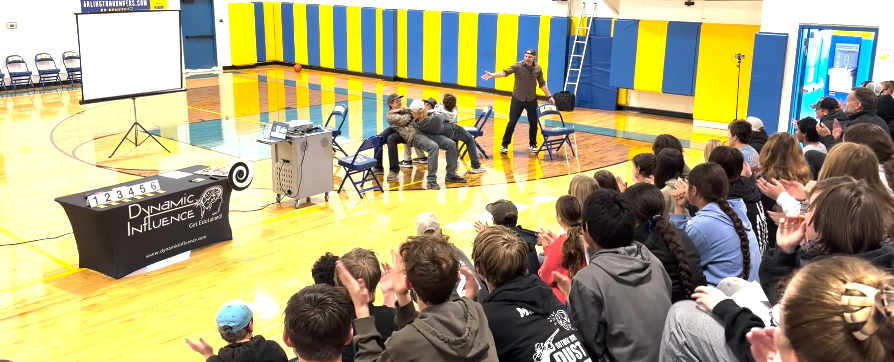
On November 3, 2026, substance awareness speaker Robert Hackenson Jr. brought Sober Thoughts to students at Arlington High School in Arlington, OR. Through magic, illusions and student volunteers, they learned how decisions get made, what influences them, and how to handle pressure, stress and the “it's safe” marketing behind vapes and pills. Watch the full presentation, then open any section below to keep the conversation going at home.
| Program | Sober Thoughts, a high school substance awareness assembly on decision-making, peer pressure and substance use |
|---|---|
| School | Arlington High School (Arlington Community Charter School), 1200 Main St, Arlington, OR 97812 (Gilliam County) |
| Date | November 3, 2026 |
| Presenter | Robert Hackenson Jr., MBA, CAOL, prevention educator and professional magician, Professional Member of the National Speakers Association |
| Format | One interactive assembly using magic, illusions and student volunteers; non-fear-based |
| Topics | Building your life, peer pressure, stress and coping, vaping and nicotine, THC and the teenage brain, counterfeit pills, and who profits from “it's safe” messages |
| For families | The full recording, a parent discussion guide, printable discussion cards, and Gilliam County and Oregon help lines |
First, it showed high school students how decisions happen and what gets in the way: peer pressure, stress, boredom and marketing. Then it gave them practical tools, for example refusal lines, a code word for getting out of a bad situation, and three rules for any risky choice.
Substance awareness speaker Robert Hackenson Jr. of Dynamic Influence presented it in Arlington. He is a prevention educator and professional magician with more than 20 years of experience who has spoken to schools in 49 states.
Set up a code word with your teen. That way, they have a way out of an uncomfortable situation without losing face with friends.
People usually say “you only live once” right before something dumb. Students heard the opposite: if you only get one life, then that's the reason to make the smart choice. In the chair circle, volunteers held each other up, but when one let go, everyone fell. Similarly, big decisions stack on each other.
An optical illusion made Robert's head seem to shrink and grow, and students laughed before they thought. Many decisions work the same way, so it pays to decide in advance.
Peer pressure rarely looks like someone forcing you. Instead, it's a snap decision you make while worrying how you look. That's why students practiced low-drama lines (“Nah, I'm good,” “My parents test me”). They also heard about a code word: text “fine,” and then a parent calls to “make” them come home.
Be prepared, not scared.“Be productive, not destructive.” A lobster grows by shedding a shell that's gotten too tight, so discomfort is a signal to grow. On the other hand, using a substance to escape every hard moment trains the brain to keep reaching for it.
Robert shared how he made poor choices in middle school during a hard time at home. Then a counselor helped him picture the life he wanted. He also explained that comparison steals joy, because we compare our whole truth to other people's social masks.
It's not about the hand you're dealt. It matters how you play the hand.Fake oxycodone, Xanax and Adderall can look identical to the real thing and still contain fentanyl. Also, splitting a pill doesn't make it safer. So take medicine only as directed, and never take someone else's.
21 is the legal age because the brain keeps pruning and wiring until the mid-20s. Besides, “it's natural” isn't an argument (so is poison ivy). In addition, today's THC is far stronger than a generation ago.
The only people calling vaping safe are those who use it and those who sell it. In reality, vapes make an aerosol, not water vapor, and the FDA approves their ingredients to eat, not to inhale. Students also heard how companies marketed vaping to teens with candy flavors and USB-drive designs.
A volunteer agreed to a coin flip before hearing the stakes. (Nobody got hurt.) The lessons: first, get all the information and consider the source; second, don't put your health in someone else's hands; and finally, if there's nothing to gain and everything to lose, find your way out.
Thoughts become words, words become actions, actions become habits, habits become behavior, behavior becomes character.Each one ties back to something the substance awareness speaker did on stage in Arlington. For instance, try one in the car, where nobody has to make eye contact. Prefer paper? Then print the parent discussion cards.
“Which trick fooled you the most? How did he connect it to decisions?”
Every trick carried a lesson, so teens who explain the trick usually explain the lesson too.
“When something gets offered at a party, what do kids usually say? What would you say?”
Rehearsed lines come out under pressure, so offer to be the excuse.
“Let's pick a code word. If you text it, I'll come get you. No questions that night.”
As a result, your teen gets out of a bad spot without losing face. Then talk about it calmly the next day.
“Who do you think benefits when teens believe vaping is harmless?”
Teens hate being played, so seeing the marketing works better than any warning.
“What stresses kids at Arlington most, and what actually helps?”
In general, asking about peers gets more honest answers than asking about them directly.
Unresponsive, slow breathing or pinpoint pupils can mean an overdose, so call 911 right away. Naloxone (Narcan) reverses opioid overdoses, and pharmacies sell it without a prescription. Also, Oregon's Good Samaritan law protects anyone who calls 911 for an overdose from arrest for drug possession.
These are the figures behind what the substance awareness speaker in Arlington, OR told students.
No. Sober Thoughts is non-fear-based. Instead of worst-case images, students learned how influence works. Then they practiced what to say and do.
For an adult smoker who switches completely, it is likely less harmful. For a teen who doesn't smoke, however, it isn't safer. In fact, it's a new risk they didn't have before, because nicotine hooks a developing brain fast.
Only for adults 21 and older. Students also heard why: the brain keeps wiring itself into the mid-20s. On top of that, today's THC is far stronger than a generation ago.
Yes. Robert told students they can say “my parents test me” as an easy way out. So say out loud that you'll back them up. It costs nothing and helps.
Please share it only within your family. Students appear on camera, and for that reason this page names no volunteers.
At school
Gilliam County
Oregon
National
These lines are free and staffed 24/7.
Robert Hackenson Jr. brought this substance awareness assembly to Arlington, OR at Arlington High School, making him a prevention speaker in Gilliam County, Oregon and a vaping awareness speaker for Eastern Oregon schools. Based in Shrewsbury, Massachusetts, he works with high schools in Oregon and nationwide, with follow-up curriculum, discussion cards and parent resources included with every Sober Thoughts assembly.
Check availabilityPresentation recordings are for family viewing only and may not be redistributed.