
Highly Interactive & Engaging Educational Speaker
The latest school bullying statistics show a four-point jump in two years — and reveal where bullying actually peaks. Here's what the data means for 2026-27 district planning, and what prevention actually works.
If you're a principal, counselor, or PTO leader doing fall planning right now, the school bullying statistics for 2026 should be on your desk before you finalize a single agenda. The CDC's Youth Risk Behavior Survey tells a story that contradicts the comfortable narrative that "kids are bouncing back."
They're not bouncing back. Not when it comes to bullying. Here's what the latest data actually says, who it's hitting hardest, and what the research shows about prevention strategies that actually work.
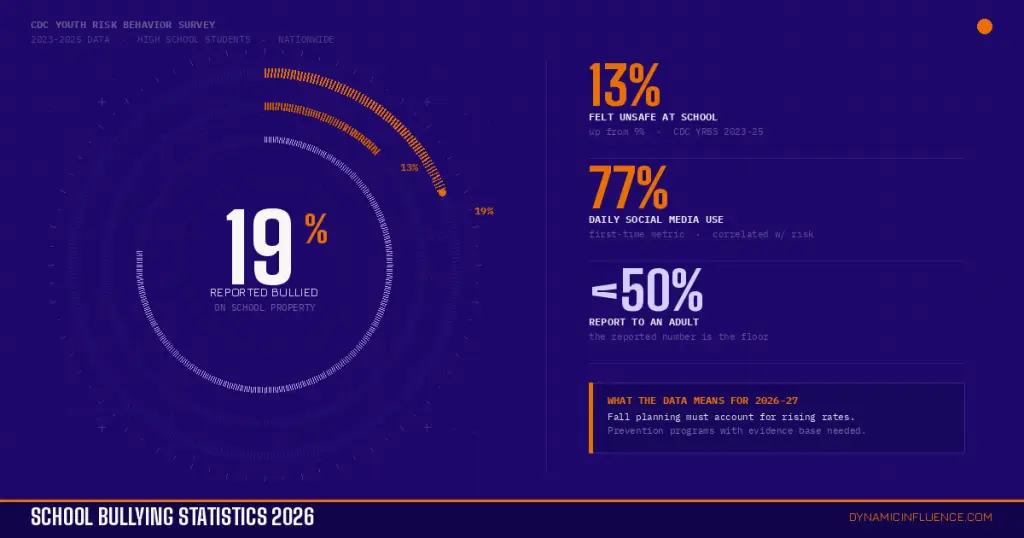
In the most recent CDC data, 19% of high school students reported being bullied on school property — up from 15% two years earlier. For a school of 1,200, that's nearly 50 more students reporting bullying each year. And those are only the ones reporting: fewer than half of bullied students tell a school adult.
I've sat in dozens of administrator meetings where someone says, "Our incident reports are flat." Flat reports don't mean flat bullying. They often mean students have stopped telling you.
The reported number is the floor, not the ceiling.
— Robert Hackenson Jr., 20+ years presenting in 49 statesHere's what most back-to-school coverage misses: the high school numbers aren't the high-water mark. Bullying peaks in middle school and declines as students get older. A 6th grader is nearly three times as likely to be bullied at school as an 11th grader.
And it starts even earlier. Independent studies show roughly 22% of third graders are bullied two to three times a month or more. Bullying starts in elementary, peaks in middle school, and hardens into something students stop reporting by high school — younger kids are far more likely to tell an adult, and that willingness shrinks every year.
Bullying looks different in 3rd grade than in 8th than in 11th. A flat day rate brings one trusted voice to elementary, middle, and high school — up to 4 presentations in 24 hours, shared across schools and budgets.
See Flat Day Rate Pricing →For the first time, the latest survey asked about social media use — and found that frequent use correlates with higher bullying, sadness, and suicide risk. For most students, school bullying and online bullying are now one continuous experience. The 3 PM bell doesn't end it. It follows them home.
Here's where most articles go vague. Let me be specific. The interventions with the strongest evidence base:
October is Bullying Awareness Month, and quality speakers book up fast over the summer. Lock in your date before the calendar fills.
Explore Our Presentations & Resources →About 19% of U.S. high school students reported being bullied on school property in the past year, up from 15% two years earlier. Because fewer than half report it to an adult, the true number is likely higher.
Bullying peaks in middle school. Sixth graders report the highest rate (about 27%), followed by seventh (26%) and eighth (25%), then it declines through high school — eleventh graders report the lowest at about 10% (NCES).
Yes. An experienced speaker can tailor age-appropriate messaging for elementary, middle, and high school. A flat day rate allows multiple presentations across grade levels and schools in a 24-hour window, letting schools share costs and deliver one consistent district-wide message.
The strongest evidence supports schoolwide programs involving every adult, trusted anonymous reporting, bystander training, culture-setting events early in the year, and sustained follow-through beyond one-time assemblies.
Every statistic in this article is drawn from federal data and primary research. Links below open in a new tab.
CDC Youth Risk Behavior Survey (2023)Source for the 19% bullied at school, 13% missed school due to safety concerns, 16% cyberbullied, and demographic breakdowns for U.S. high school students.
CDC 2023 YRBS Results· Data Summary & Trends Report 2013–2023 (PDF)· YRBSS Hub
MMWR Supplement (October 2024) — Frequent Social Media Use & BullyingSource for the 77% frequent social media use figure and the association between social media use, bullying victimization, and mental health risk.
CDC MMWR Supplement· PMC Full Text
National Center for Education Statistics (NCES) — School Crime Supplement, 2021–22Source for the grade-level breakdown showing bullying peaks in middle school (27% of 6th graders, declining through high school) and the 19% overall figure for grades 6–12.
NCES Fast Facts: Bullying· Condition of Education: Student Bullying· 2022 SCS Full Web Tables
CDC Youth Violence Prevention — About BullyingSource for the school-level data: 28% of middle schools, 15% of high schools, and 10% of elementary schools report bullying at least weekly.
StopBullying.gov — Federal Bullying Prevention ResourceReference for evidence-based prevention strategies and the broader federal framework on bullying prevention.
Facts About Bullying· StopBullying.gov Home
Cyberbullying Research Center — Patchin & HindujaIndependent research on cyberbullying prevalence and trends in U.S. teens, including longitudinal data showing lifetime cyberbullying exposure has more than doubled since 2007.
We use cookies to improve your experience on our site. By using our site, you consent to cookies.
Manage your cookie preferences below:
Essential cookies enable basic functions and are necessary for the proper function of the website.
These cookies are needed for adding comments on this website.
Statistics cookies collect information anonymously. This information helps us understand how visitors use our website.
Google Analytics is a powerful tool that tracks and analyzes website traffic for informed marketing decisions.
Service URL: policies.google.com (opens in a new window)
SourceBuster is used by WooCommerce for order attribution based on user source.
You can find more information in our Cookie Policy and .