
Why Your Messages Get Misread at Work and School
Senders think their tone comes through. Readers think they read it right. Nearly half the time, at least one of them is wrong.
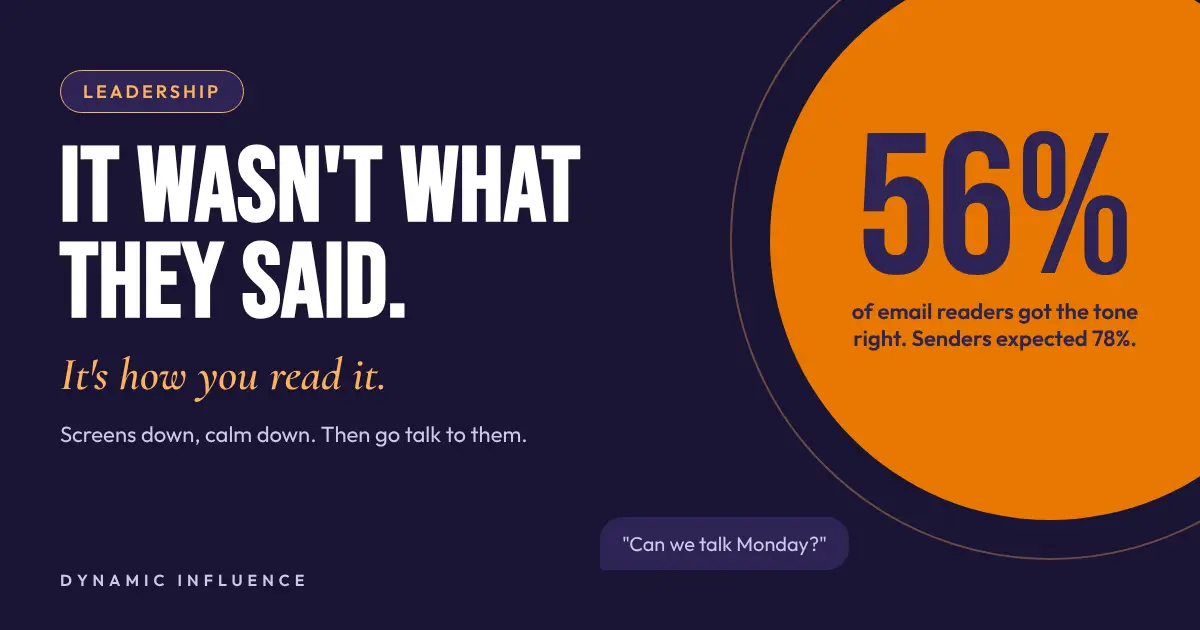
It’s 4:52 on a Friday. You fire off a quick message: “Can we talk Monday?” Five words. You meant, “I have a small question, no big deal, enjoy your weekend.” That’s how messages get misread.
Now picture the person on the other end. Maybe it’s a teacher reading an email from their principal. Maybe it’s a project lead reading a Slack message from their boss. They read those five words and spend the whole weekend wondering what they did wrong.
Same message. Two completely different stories. And the only one who knows what you meant is you.
I talk to students, colleges and companies all over the country. One thing I keep hearing everywhere I go: our ability to actually talk to each other, especially when there’s conflict, is slipping. It’s a lot easier to pick up a phone and type than to walk down the hall. So let’s talk about why messages get misread, and what you can do about it this week.
The trap: we react first, and justify after
In my school programs, I do an illusion where my head appears to shrink and then grow. People laugh, gasp, freak out. Then I tell them the truth: my head didn’t actually change size. If it had, I’d be dead, and that’s not funny. But you laughed anyway.
That’s the point. We like to think we’re logical. Think first, then act. That’s what we’re taught our whole lives. The truth is usually the other way around. We react first, then we come up with the reason afterward. “I snapped because I was having a bad day.” “I replied that way because of what they said last week.” Fill in the blank.
Now add mood to the mix. When you wake up in a bad mood, your brain goes looking for proof to back that feeling up. Somebody could compliment your shirt and your brain says, “They don’t mean it.” So when a short, flat message lands on a bad day, your brain doesn’t read it neutral. It reads it as an attack.
Here’s the example I use on stage. Say someone texts me, “Rob, you’re so stupid.” No LOL. No winky face. Is that a joke between friends, or a shot at me? It’s open for interpretation. And how do I interpret it? Depends on my mood. Bad mood? “I’m stupid? You’re stupider.” Gloves are off. Or worse, I don’t go to that person at all. I post something vague to everybody else and wait for sympathy.
Adults do the exact same thing. We just use longer words and copy the whole department.
Why messages get misread: the research
This isn’t just a hunch. In a set of studies published in the Journal of Personality and Social Psychology, researchers Justin Kruger and Nicholas Epley had people send statements meant to sound either sarcastic or serious. According to the American Psychological Association’s write-up of the research, senders expected their recipients to get the tone right about 78% of the time. People who heard the message spoken got it right about 75% of the time. People who read it in an email? 56%, not much better than a coin flip.
And here’s the part that should make every leader pause: the readers were confident too. They thought they’d interpreted the tone correctly about 90% of the time. As NYU Stern’s summary of Kruger’s research puts it, senders “were typically overconfident that their intent was fully grasped by recipients.”
So the sender is sure they were clear. The reader is sure they understood. And nearly half the time, the reader got it wrong. That’s how messages get misread every day.
Now stack that on top of where people are right now. The APA’s Stress in America 2026 report, released in October, found that 51% of U.S. adults feel “too emotionally drained” to stay engaged with everything happening in the world, and 47% have pulled back from at least one form of social participation over the past year because of stress, uncertainty or feeling overwhelmed. Drained people read messages in a bad mood. And a bad mood looks for proof.
Schools are feeling it with families, too. Education Week reported this month that some teacher-prep programs now build in dedicated training on working with parents, a skill many new teachers say they don’t feel prepared for. When the hard conversations are happening, they’re often happening in an inbox first.
When messages get misread, screens down
Here’s what I tell students, and it works just as well in a front office or a conference room. When a message makes you upset, the first thing you do is the opposite of what you want to do: screens down. Calm down first. Then, once you’re calm, go talk to them.
Face to face makes you uncomfortable? Good. That’s a growth moment, something to work through, not run from. Can you call instead? Absolutely. Phones still do that. Video call, even better. Can you just text back? No. Not for this one.
When you’re actually talking to someone, you can read them and hear them. You can see the moment something lands wrong and back off. Over a screen, you can’t. You just keep going.
Try this
- For school leaders: Before you send a parent or staff email about anything sensitive, read it out loud in the flattest, grumpiest voice you can. If it sounds like a threat that way, someone will read it that way. Add a sentence of context, or pick up the phone instead.
- For workplace leaders: Retire “Can we talk?” with no context. Say what it’s about and how big it is: “Quick question on the budget slide, nothing urgent.” Five extra words can save someone a weekend of worry.
- For both: Make a personal rule. When a message spikes your heart rate, you don’t reply in writing until you’ve walked away, calmed down, and decided whether this needs a conversation instead. If it does, go have it.
Your turn
What’s the last message you reacted to before you checked what they meant?
And be honest. Was it their words, or your mood, that wrote the story?
Bring this to your team
A leadership session on handling conflict, reading people and actually talking things through, for school staff or company teams.
Messages get misread: common questions
Why do emails and texts get misread so often?
Messages get misread because written messages strip out tone of voice, and research by Kruger and Epley found that senders consistently overestimate how well their tone comes through. On top of that, a reader’s mood shapes how they interpret anything ambiguous, so a neutral message can feel like an attack on a bad day.
What does “screens down, calm down” mean?
It’s a simple rule from Robert’s programs: when a message upsets you, put the device down and let the emotion settle before you respond. Once you’re calm, have the conversation in person, by phone or by video, not by text.
Is this leadership program for schools or businesses?
Both. The same skills, managing your own reactions, reading other people and resolving conflict face to face, apply to school administrators, teachers, managers and teams. Robert adapts the examples to the audience in the room.
Leave a Reply