
Your Kids Are Watching How You Handle Holiday Stress
Stress isn’t the problem. What our kids watch us reach for when we’re stressed is the lesson they keep.
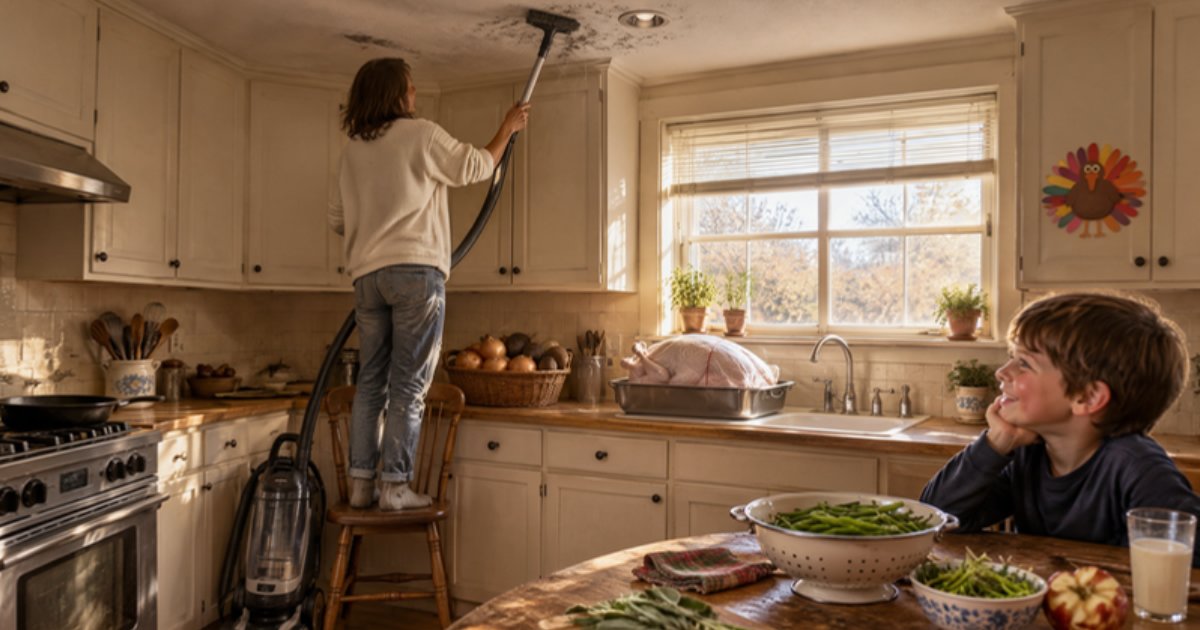
It’s the day before Thanksgiving. The turkey is thawing (you hope). Someone just texted that they’re bringing a plus-one. And you’re standing on a chair with the vacuum, cleaning a spot on the ceiling nobody has ever looked at in the history of your house. Welcome to holiday stress.
If that’s you right now, first of all, welcome. Second, put the vacuum down for a second, because I want to tell you something you probably don’t hear much this time of year.
Good. I’m glad you’re stressed.
Why I tell a room full of kids I’m glad they’re stressed
When I speak at schools, I ask, “Who here is stressed?” The hands go up, even in elementary school. Then I say, “Good. I’m glad you’re stressed.” They look at me like I pulled a rabbit out of the wrong hat (just kidding, I don’t use rabbits).
Here’s why I say it. Stress is normal. It’s your body handing you energy to get through whatever is in front of you. When a deadline is approaching and we don’t feel prepared or the task is not completed, suddenly we get that jolt. That jolt is the stress doing its job. What is important is how we view and use that jolt.
For example, company is coming, and suddenly we’re vacuuming the ceiling, doing things we would never normally do. In other words, that’s stress ramping up… and it’s ok.
And there is always going to be stress. Middle school, high school, college, a career, kids of your own. The bigger the kids get, the bigger the responsibilities and bigger the problems. So the real question isn’t how to make stress go away. It’s whether our kids get good at it now.
The trap: “Don’t be stressed, here, have this”
The problem is what we’ve been taught to do with stress. As a society we basically say, “You’re stressed? Here, have a drink. Have a pill. Have a vape.” There’s even stress-relief soap. Soap! The message underneath all of it is: stress is bad, escape it, grab something.
That’s the part I worry about. Kids’ brains are still making connections on what to do during certain situations. If what they learn is “whenever I get stressed, I turn to a substance,” that’s a life lesson they can carry for a long time. And where do they learn it first? Usually by watching us.
Think lobster
So here’s the picture I give kids. A lobster’s shell doesn’t grow. The lobster grows inside it until the shell gets too small and it feels uncomfortable. So it hides in the rocks, sheds the old shell, and grows a new one. Then it does it again. How does a lobster know it’s time to grow? It feels uncomfortable and starts to stress out.
For our kids, those uncomfortable moments are growth moments. Something to work through, not run from. Our job is to coach them through, not mow down every obstacle in their path. Let them try. Let them fail sometimes. Be there to pick them up and ask, “What’d you learn? How do we move forward? What are healthy coping techniques? How can you use this stress jolt?”
What the research says about holiday stress
You are not alone in feeling the squeeze. In the American Psychological Association’s Stress in America 2026 report, released in October, 72% of adults agreed that “stress is just something I have to live with,” and 77% named cost of living as a significant stressor.
Holiday stress piles on. In last year’s American Psychiatric Association Healthy Minds poll (November 2025), 41% of adults expected more holiday stress than the year before, up from 28% in 2024.
Parents carry an extra load. The U.S. Surgeon General’s 2024 advisory on parents found 48% of parents say most days their stress is completely overwhelming, compared to 26% of other adults. And in an April 2026 Kids Mental Health Foundation survey, 97% of parents said they’d felt parenting-related stress in the past month, and nearly half of stressed parents (46%) feel it also makes their kids more anxious or worried.
Kids are watching what we do with it
So kids notice our holiday stress. That’s not a guilt trip, it’s actually good news, because it means they’re also noticing what we do with it. The National Institute on Alcohol Abuse and Alcoholism puts it plainly: “Parents influence whether and when adolescents begin drinking as well as how they drink,” and how parents themselves drink is part of that. Their parent guide adds, “Don’t communicate to your child that alcohol is a good way to handle problems.”
And the “stress is energy” idea isn’t just me being an optimist. In a 2022 study published in Nature and summarized by the NIH, researchers gave teens and college students a roughly 30-minute online lesson teaching that stress responses can help performance, along with a growth mindset. Across six randomized, controlled experiments, the lesson improved measures including students’ stress responses, well-being and academic outcomes. That was a student study, not a parenting study, but the takeaway carries over: how we think about stress can change what it does to us.
Try this: three things for this week
- Narrate your coping out loud. Kids can’t see what’s going on in your head, so say it. “I’m stressed about getting dinner on the table, so I’m going to take a ten-minute walk first.” Or, “I’ve got too much to do, so I’m picking the top three and letting the rest go.” You just modeled prioritizing and a healthy outlet in one sentence. Bonus: try my slow-breathing exercise together. Breathe in slowly, then out slowly, and stretch it as long as you comfortably can. It feels weird. That’s fine.
- Have a lobster moment. At dinner or in the car, tell the lobster story and ask, “What’s something that felt uncomfortable for you this year that ended up helping you grow?” Then share one of yours.
- Watch how the drink shows up at the table. This isn’t about whether adults have a glass of wine at Thanksgiving. It’s about the line that goes with it. “Ugh, what a day, I need a drink” teaches something different than “Cheers, I’m glad we’re all here.” Try catching the “I need this to unwind” framing and swapping in something else that helps you reset, like a walk after the meal.
Holiday stress and what you reach for
Not for your kids. For you. This week, when the oven timer is going off and the relatives are running late and someone spills gravy on the good tablecloth:
When you’re stressed, what do your kids see you reach for?
No judgment. Just notice how holiday stress shows up in you. After all, that noticing is where it starts.
Happy Thanksgiving. Go easy on the ceiling.
Bring this to your school
Beyond “Just Say No” gives students and parents practical tools for stress, substances and choices, with a little magic to keep it fun. Also, every session is tailored to its audience. For example, families can get the recorded parent presentation as a bonus, or instead your school can add a live evening parent night, in person or virtual.
Holiday stress: common questions
Is it bad for my kids to see me stressed?
No. Holiday stress is normal, and kids seeing it is part of life. What matters most is what they see you do next. Naming it and handling it in a healthy way teaches them they can do the same.
Is it okay to drink in front of my kids at the holidays?
That’s a family decision. The NIAAA’s guidance focuses on the message: don’t communicate that alcohol is a good way to handle problems. Pay attention to how drinking is framed, not just whether a glass is on the table.
What’s a simple coping skill I can teach my child?
Slow breathing, a walk outside, exercise, music or writing it out. Try one together, and when you’re overwhelmed, model prioritizing: pick what matters most first and let the rest wait.
Sources
- Stress in America 2026 report
- Healthy Minds poll
- 2024 advisory on parents
- Kids Mental Health Foundation survey
- “Parents influence whether and when adolescents begin drinking as well as how they drink,”
- “Don’t communicate to your child that alcohol is a good way to handle problems.”
- Nature
- summarized by the NIH
Leave a Reply