
Why Our Family Uses the Word “Pizza” as an Exit Plan
One boring word, picked at the kitchen table, can get your kid out of a bad situation without losing face.
You pull up to the house. Porch light on, cars in the driveway, music leaking through the windows. Your kid is already halfway out of the car before you finish saying “Have fun, text me.” Then you spend the next three hours glancing at your phone like it owes you money. That’s where a teen code word helps.
Starting next week, a lot of us are going to live that moment more than once. Thanksgiving week kicks off a long run of gatherings, sleepovers and parties that stretches right up to winter break. So here’s the one thing my family does that I’d want every parent to steal.
It’s a single word, a teen code word. For my kids, that word is “pizza.”
What peer pressure really looks like
Most of us picture the movie version of peer pressure: kids chanting, a drink in your face, nobody letting you leave. If that’s happening, the answer is easy. Call someone, and get new friends.
But that’s rarely how it goes. Most of the time, peer pressure is a kid in a situation they didn’t prepare for, making a split-second decision while wrestling with their own insecurities. It’s a friend, maybe a childhood friend, casually saying, “Here, you want to try this?” And now your kid has about two seconds to answer.
In those two seconds, their brain isn’t weighing health risks. It’s running the image math. If I say no, what will they think of me? If I say yes, what will they think of me? Maybe it’s an upperclassman. Maybe it’s someone they really like. Suddenly it feels like the whole room is waiting on their answer.
Here’s what I tell students: the room isn’t watching. Everyone there is just as self-absorbed as you are, worried about how they’re standing and what they look like. Every one of them is “the main actor in their own movie in their head.” The spotlight is mostly imaginary. The freeze it causes is real.
That’s why my whole approach comes down to three words: prepared, not scared. Kids need a plan they made before the moment showed up.
Our family’s teen code word
My kids are at the age where I need to think about this stuff now. So whenever I drop them off at a party, we have a code word.
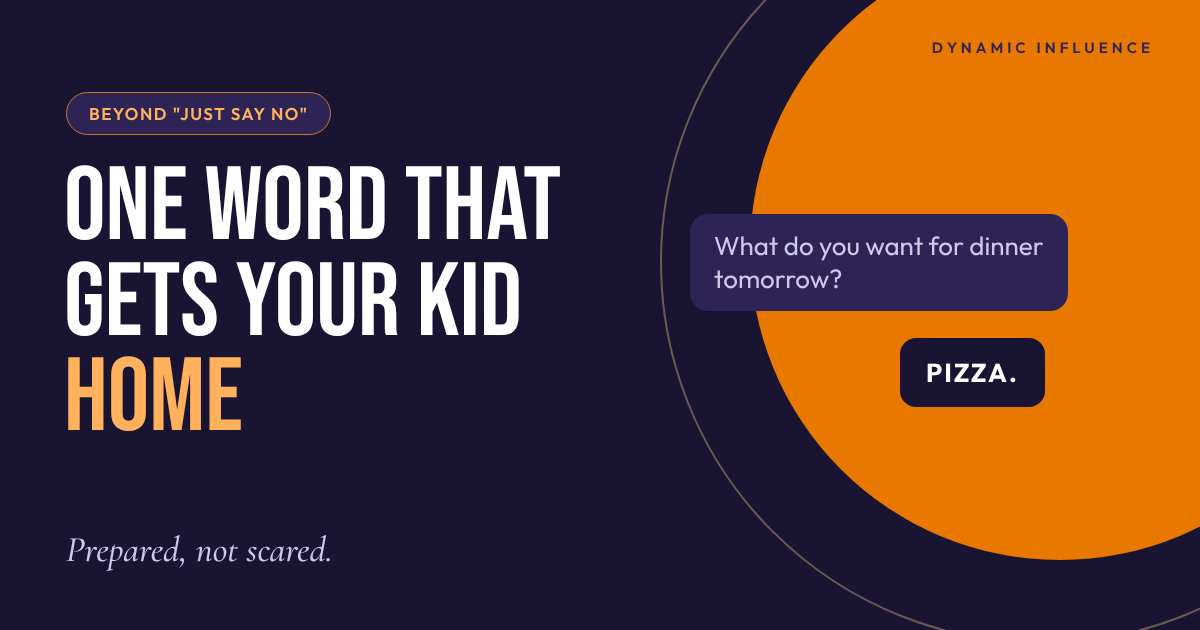
At some point I’ll text my kids, “What do you want for dinner tomorrow?” Any time during the night, they can text back one word: PIZZA. To anyone reading over their shoulder, that’s the most boring reply on earth. To me, it means, “I’m uncomfortable, and I want to come home.”
And that’s my cue to become Crazy Dad. I call and announce that they didn’t clean their room and I’m coming to get them. Right now. They say “What?”, tell their friends, “I know, he’s crazy,” and when someone asks what they texted me, they shrug: “He asked what I wanted for dinner. I said pizza.”
They get out. They keep their dignity. I’m the bad guy, and I’m thrilled to play the part.
The teen code word itself doesn’t matter. What matters is that the decision got made at the kitchen table, on a calm night, long before anyone at a party said, “Here.”
Why a teen code word works
I’m a magician, so I appreciate a good trick. This one happens to have research behind it.
Deciding ahead beats willpower in the moment. Psychologists call these “if-then” plans, or implementation intentions: if this happens, then I’ll do that. A 2006 meta-analysis by Gollwitzer and Sheeran, summarized by the National Cancer Institute, found that forming if-then plans had a medium-to-large effect on reaching goals across 94 studies (d = .65). A teen code word is an if-then plan your kid can carry in their pocket.
Teens really do feel the room more than we do. A 2011 Temple University study by Chein, Steinberg and colleagues, published in Developmental Science and titled “Peers increase adolescent risk taking by enhancing activity in the brain’s reward circuitry,” put people in a driving game. Only the adolescents took significantly more risks when peers were watching, and the reward regions of their brains lit up more. That’s not a character flaw, and it’s one more reason a plan made in advance helps.
What the numbers say
Most seniors aren’t drinking. In the NIH Monitoring the Future survey released in December 2025, 41% of 12th graders reported alcohol use in the past 12 months. That means 59% of seniors didn’t report drinking in the past year. Your kid saying “Nah, I’m good” puts them in the majority.
December matters. A 2012 SAMHSA report, using 2002–2010 survey data, found that on an average day in June, July or December, more than 11,000 youths used alcohol for the first time, and December is one of the peak months for first use. That’s a good reason to have the code word conversation this week instead of in January.
And you matter most. SAMHSA’s “Talk. They Hear You.” campaign puts it plainly: “Parents and caregivers have a significant influence on their children’s decisions about using alcohol and other drugs.” They’re listening, even when they act like they aren’t.
Try this this week
- Pick the word together tonight, and keep it boring. Let your kid choose it. The best code words are ones nobody would look at twice, like “pizza.” Pair it with a normal-sounding question you’ll text, so the reply blends right in.
- Agree on the rule: no interrogation tonight, we talk tomorrow. If they use the word, you come get them. The car ride home is for “I’m glad you called.” The real conversation can wait until everyone has slept. Still say hi when they get in, even if it’s late. Knowing you’ll check on them gives them one more reason to make the smart call.
- Role-play the offer and the exit once. You play the friend: “Here, you want to try this?” Let them practice an easy out, like “Nah, I’m good,” or blaming you (I fully endorse this one). Then practice sending the word. It’ll feel silly. Rehearsed beats frozen.
The question that decides everything
If your kid needed out of a situation tonight, how would they tell you without losing face?
Now the harder one: what would happen when they did? If the last time they called for help it turned into a lecture in the driveway, the code word won’t get used, no matter how clever it is. The plan only works if your reaction is safe.
Bring this to your school
Beyond “Just Say No” gives students and parents practical, non-fear-based tools for the moments that matter. It’s funny, there’s a little magic, and nobody leaves scared. Also, every session is tailored to its audience. For example, families can get the recorded parent presentation as a bonus, or instead your school can add a live evening parent night, in person or virtual.
Teen code word: common questions
What if my teen thinks a code word is cheesy?
They probably will, at first. Let them pick the word and the question so it’s theirs, not yours. It’s insurance. They may never need it.
Should I punish them after a pickup?
If the word gets them in trouble, they’ll stop using it. Treat the pickup as the win. You can still talk about what happened the next day, calmly, and ask them what they think they’d do differently.
What age should we start?
Start when they start going places without you: sleepovers, parties, hanging out at a friend’s house. Earlier is easier, because a younger kid thinks a secret family word is cool.
Leave a Reply