
Let’s Talk Respect
Everything from the assembly, in one place.
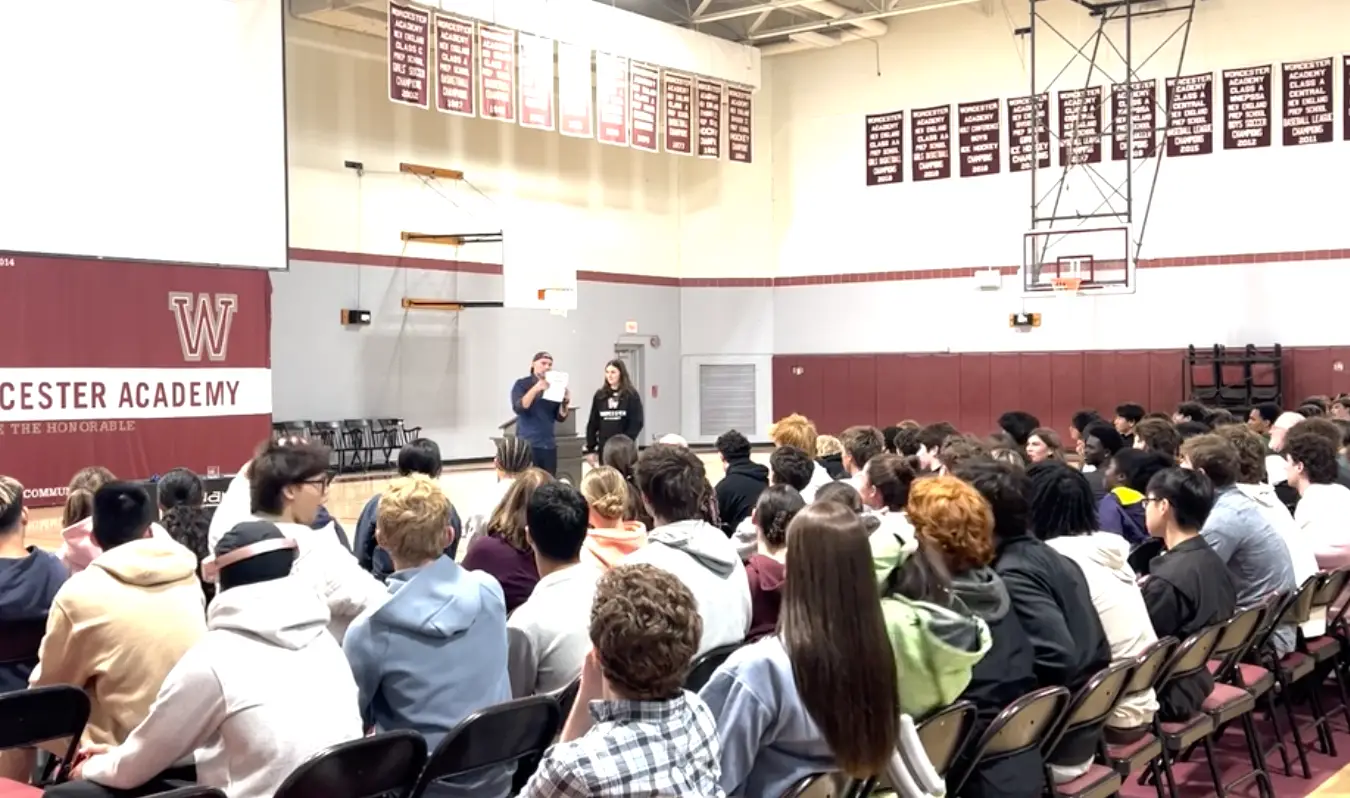
| Program | “Let’s Talk Respect” — a bullying prevention and school culture assembly built around live magic and audience demonstrations. |
|---|---|
| School | Worcester Academy, 81 Providence Street, Worcester, Massachusetts 01604. |
| Presented by | Robert Hackenson Jr., MBA, CAOL, founder of Dynamic Influence — a professional magician, certified hypnotist and prevention educator with over twenty years in schools across 49 states. |
| Format | Two separate 50-minute assemblies: one for grades 7–8, one for the Upper School. |
| Topics | Emotional regulation, empathy, conflict resolution, miscommunication by text, cyberbullying, bystander intervention, and where to go for help. |
| For families | Both recordings, a parent guide and conversation cards for each division, and Worcester-area support resources — all free, all below. |
No. Grades 7–8 and the Upper School got different talks — different demonstrations, different language, and different breathing counts. Make sure you download the guide and watch the recording for the one your student was actually in.
No. The approach is deliberately non-fear-based. There are no shock statistics and no horror stories. Students get the reasoning and the tools rather than a warning, on the premise that a young person who understands why makes better decisions than one who has been frightened.
Ask one question, and read the parent guide for your student’s division. That’s it — the guide is short, and it has conversation openers that work better than anything you’ll improvise at the dinner table.
The Worcester Academy bullying prevention assembly ran twice, and each division has its own parent guide and its own conversation cards. They are free, there’s no form, and the guide is where the full detail lives — this page is just the map.
Ask them about: the shoe that was sealed inside a padlocked box nobody touched.
For teachers: Teacher Guide · Student Guide · Classroom Poster
Ask them about: the name a student wrote down, and where that card turned up.
For teachers: Teacher Guide · Student Guide · Discussion Cards · Poster · Communications Kit
“Blowing out somebody else’s candle never makes yours glow any brighter.”
He says it in both rooms, and it is the hinge of the entire program. Cruelty is not strength. It reads as insecurity to everyone watching, which is both the moral argument and, for a teenager, the practical one.
Roughly 50 minutes each. Watch the one your student was in — they are genuinely different talks. Both are password protected, and Worcester Academy sends the access code to families by email.
Password protected — the school emails families the access code.
Password protected — the school emails families the access code.
You do not have to run a session. The highest-value thing you can do this week takes about forty seconds, and it’s the same question for both divisions.
“Who at school would you go to if something was wrong?”
It isn’t the answer that matters most — it’s how long it takes. An instant name is good news. A long pause is the thing worth following up on, and worth telling the school about. The answer may be a dorm parent, a coach or an advisor rather than a teacher, and all of those count.
An assembly lands days later, sideways, usually in a car. Ask once, let it go, leave the door open. The conversation cards exist so you don’t have to invent a question on the spot.
Nothing in either assembly says teenagers are the problem or that screens should be confiscated. If your first move is a device check, you’ve confirmed that talking to you is risky.
The breathing count, the billboard test, walking around to someone’s side instead of pulling on the rope — none of it is age-restricted. A parent visibly using it beats a parent recommending it.
The “who would you go to” question matters more, not less, and the honest answer may be somebody you’ve never met — ask for the name, then ask whether they’d actually go to them at eleven at night. And since almost everything in this program argues against sorting conflict out by text, that applies to you too: when something is actually wrong, call or FaceTime rather than message.
Yes, and the magic is load-bearing rather than decorative. Each illusion is the argument: an optical illusion proves we react before we think; a shoulder tap proves you can hurt someone you never touched; a coin-and-bill prediction proves how much you read off a person’s body that a text can’t carry. A student who remembers the trick has, functionally, remembered the lesson attached to it.
They’re pitched to the room. Grades 7–8 learn exhale first, in for 10, hold 5, out for 10. The Upper School learns exhale first, in for 15, hold 5, out for 15. Longer holds are harder, and the difficulty is part of the point — it’s a self-control exercise, not a relaxation exercise. Either count works for anyone. If siblings in different divisions disagree about it, they’re both reporting accurately.
No, and this is worth being precise about. The “keep your power” material — agreeing with an insult instead of fighting it — is for low-stakes verbal jabs, and it works because the fight needed two people and only one turned up. It is explicitly not the answer for anything repeated, physical, or frightening. For those, the instruction is to tell somebody: an adult at school, a parent, a dorm parent, a coach.
Quite a lot. “Nobody’s born a bully — it’s a learned behavior, but because it’s a learned behavior, you can actually unlearn it.” The program explains the motive without excusing it: it almost always runs on insecurity, and it reads as weakness to everyone watching. That gives a student a way back that doesn’t require them to accept being a bad person, which is usually the thing blocking the conversation.
Tell the school, early, in writing, and keep what you’ve got — screenshots with dates, names, where and when. Massachusetts requires schools, independent schools included, to have a bullying prevention and intervention plan and to make it available to families, so ask Worcester Academy for theirs and for the reporting route it names. Your student’s advisor or division head is the right first call. If there are threats, images, or anything that reads as criminal, that is a police matter as well as a school one.
Both assemblies were recorded and the players are above. They’re password protected, and Worcester Academy sends the access code to families by email — if you don’t have it, ask the school office rather than Dynamic Influence. Share it inside your own family freely, but please don’t repost it publicly: students appear on camera, which is also why no student who volunteered on stage is named anywhere on this page.
A professional magician and certified hypnotist who has spent more than twenty years as a prevention educator, delivering magic-integrated programs to schools, colleges and organizations across 49 states and internationally. He holds an MBA and the CAOL credential and is a Professional Member of the National Speakers Association. He has three children, one of them in high school, and says so from the stage.
Worcester Academy is the first call for anything happening at school — your student’s advisor, division head, counselor, or dorm parent. The rest of this is for everything around that.
Numbers verified October 2026 against mass.gov and UMass Chan Medical School.
You are allowed to ask your student directly whether they are okay. Asking does not plant the idea, and a clumsy question asked out of love is far better than a perfect one you never ask.
“Let’s Talk Respect” runs as a standalone assembly or as an assembly plus a classroom follow-up curriculum, and it is written separately for each grade band rather than rescaled from one script. Pre and post student surveys are available if you need to show movement to a school board or a funder.
Middle school assemblies · High school assemblies · Elementary school assemblies · Request an information packet
Founder of Dynamic Influence and a Professional Member of the National Speakers Association. A professional magician and certified hypnotist, he has spent over twenty years as a prevention educator, delivering magic-integrated programs to schools, colleges and organizations across 49 states and internationally.
His work uses a non-fear-based approach: students are given the reasoning and the tools rather than a warning, on the premise that young people who understand why make better decisions than young people who have been frightened.
Bring this program to your school → · Read what other schools say