
Let’s Talk Respect
What your student heard — and what to do with it this week.
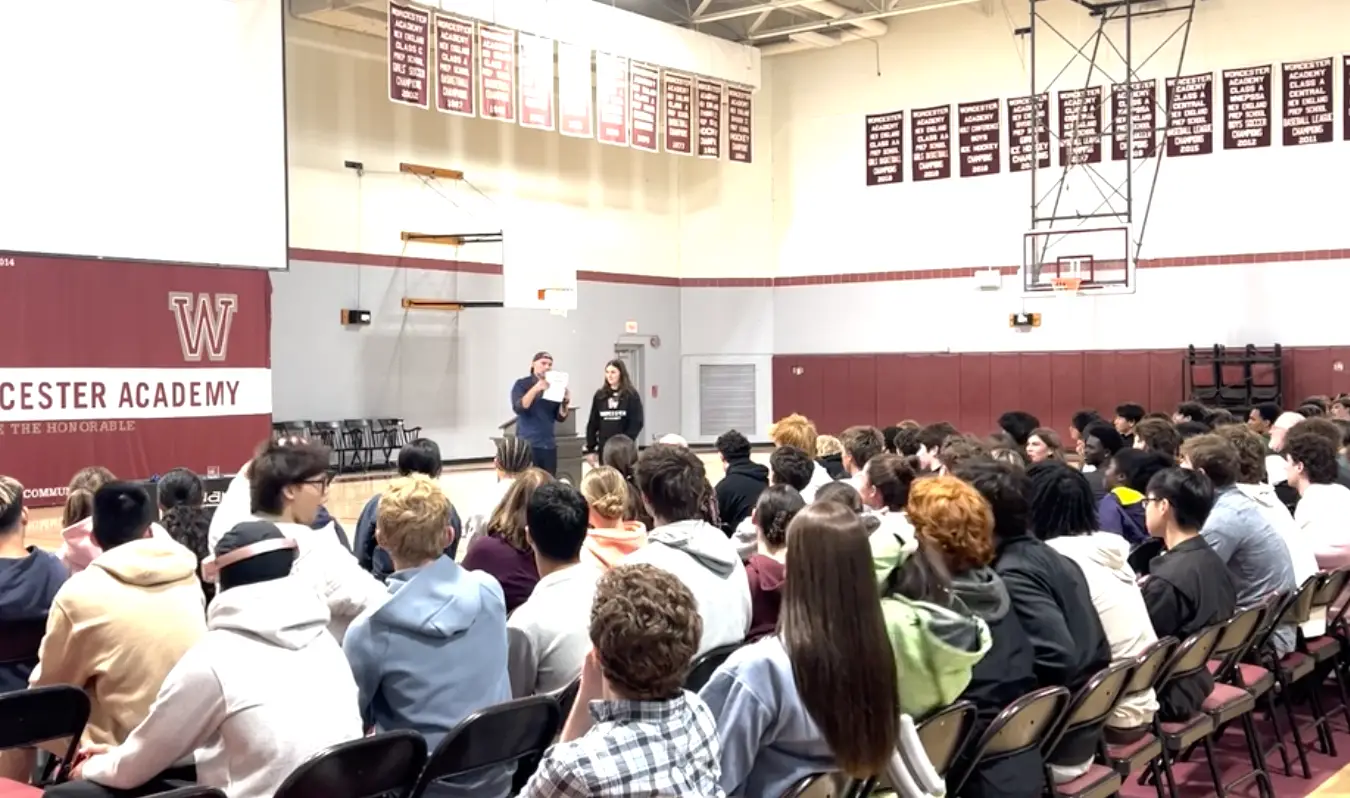
Quick answers
| Program | “Let’s Talk Respect” — a bullying prevention and school culture assembly built around live magic and audience demonstrations. |
|---|---|
| School | Worcester Academy, 81 Providence Street, Worcester, Massachusetts 01604 — an independent day and boarding school serving grades 6–12 plus a postgraduate year. |
| Presented by | Robert Hackenson Jr., MBA, CAOL, founder of Dynamic Influence — a professional magician, certified hypnotist and prevention educator with over twenty years in schools across 49 states. |
| Format | Two separate 50-minute assemblies: one for grades 7–8, one for the Upper School (grades 9–12 and postgraduates). |
| Topics covered | Emotional regulation, empathy, conflict resolution, miscommunication by text, cyberbullying, bystander intervention, resilience, and where to go for help. |
| For families | Both recordings, a parent guide for each division, printable parent conversation cards, and Worcester-area support resources — all free, all on this page. |
Was it the same presentation for both divisions?
No. Worcester Academy received two different assemblies. The grades 7–8 version opens with a shoe sealed inside a padlocked box, and spends more time on emotions, the social mask, and what happens when a text message is misread. The Upper School version opens with a student’s own handwriting appearing inside a sealed case, and goes further into judgment, AI-generated images and legal exposure, and how teenagers spend their time. Even the breathing exercise uses different counts: grades 7–8 learned exhale first, in for 10 seconds, hold 5, out for 10; the Upper School learned exhale first, in for 15, hold 5, out for 15.
What is the single most useful thing a parent can do after this assembly?
Ask one question: “Who at school would you go to if something was wrong?” It is not the answer that matters most — it is how long the answer takes. An instant name is good news. A long pause is the thing worth following up on, and worth telling the school about.
Was this a scare-tactics assembly?
No. “Let’s Talk Respect” uses a deliberately non-fear-based approach. There are no shock statistics and no horror stories. Students are given the reasoning and the tools rather than a warning, on the premise that a young person who understands why makes better decisions than one who has been frightened.
How do families watch the recording?
Both assemblies were recorded, and both are embedded on this page. The recordings are password protected, and Worcester Academy sends the access code to families by email. Parents who do not have the code should contact the school office.
Two assemblies, not one
Robert ran the program twice at Worcester Academy — once for the Middle School and once for the Upper School. They share a spine, but they are not the same talk. The demonstrations are different, the language is different, and even the breathing exercise uses different counts. So the single most useful thing you can do before reading further is know which one your student was in.
Grades 7–8
Middle School
Opens with a shoe sealed inside a padlocked box. Heavier on emotions, the social mask, and what actually happens when a text gets misread.
Go to the Middle School section →
Grades 9–12 & postgraduate
Upper School
Opens with a student’s handwriting turning up inside a sealed glass case. Heavier on judgment, AI and legal exposure, and what you do with your time.
Go to the Upper School section →
What it was not
It wasn’t an anti-bullying lecture, and nobody was told to be nice. He ruled that out in the first few minutes, in both rooms: “this isn’t like, we need to love everyone and be best friends with everyone, ’cause that’s not realistic.” Students are allowed not to click with each other. The claim is narrower and harder to argue with — that not liking the same things doesn’t make somebody an enemy, and that you can still be decent to people you’d never choose.
It also isn’t fear-based. There are no scare statistics and no assembly-day warnings. Students get the reasoning and the tools, on the premise that a student who understands why makes better decisions than a student who has been frightened.
The spine, in six sentences
Nobody is logical first
We react, then we use logic to justify what we already did. He proves it with an optical illusion that makes the whole room laugh at something that didn’t happen.
Put it down. Calm down. Then talk.
In that order, and not over text. A call counts. FaceTime is better. Working out a conflict by typing does not count.
Be curious, not judgmental
Once you’ve decided what something means, you stop asking questions. That’s the exact moment empathy stops working.
You don’t see the hurt
In person you know a joke went too far because the person is crying. Online you never see the reaction — which is what makes it easy and what makes it dangerous.
Keep your power
Bullying runs on an imbalance of power, and the reaction is usually how it changes hands. Don’t hand it over.
It’s always been this way isn’t a reason
Which is how your student ended up learning that we have all been opening bananas from the wrong end our entire lives.
The line to remember from the whole hour
“Blowing out somebody else’s candle never makes yours glow any brighter.”
He says it in both rooms, and it is the hinge of the entire program. Cruelty is not strength. It reads as insecurity to everyone watching, which is both the moral argument and, for a teenager, the practical one.
Middle School
Grades 7–8. Everything in this section is specific to the Middle School assembly. If your student is in the Upper School, skip to that section — the demonstrations and the breathing counts are different.
The Middle School assembly
It opened with a shoe
Two students came up. One held a small padlocked box and was told to protect it with his life. The other was handed a deck of cards with behaviors written on them — spreading rumors, posting kind things, respecting others, humiliating others, fighting, making fun of people, breaking people’s things — and the room called each one good or bad, fast and unanimously, which was the point. They already know. Knowing isn’t the problem.
She drew one card blind. It said shoe. Inside the padlocked box nobody had touched was a small shoe. And that is how the Middle School got to the rule of shoe: before you say something, before you do something, stop and put yourself in the other person’s shoes.
Then the real question: if everybody already knows that, why don’t we do it?
Because emotions
He walks them through a bad day as a chain reaction, and middle schoolers recognize every link. You wake up having decided the day is terrible, and your brain — which is good at its job — goes looking for evidence. Somebody compliments your shirt and your first thought is they don’t mean it. You stub your toe. A sibling finished your cereal. You get to school giving off attitude, and attitude comes right back at you, so it piles on.
“It just bubbles up like a volcano until eventually it’s that little thing. It’s almost like the needle on a balloon.”
And then your little brother says hi and gets both barrels, for nothing. That’s the part he’s after — not the big blow-up, the small unfair one at home, and the apology afterwards that starts “sorry, I was just in a bad mood.”
The guitar
He tells them a story about himself that most speakers wouldn’t. He asked his own kids to clean the playroom, went out to mow the lawn, and came back to find one drawing on the wall and the other throwing things. He picked up a little broken-stringed guitar they’d got at a carnival and smashed it.
Then he saw their faces. And he describes, honestly, what his brain did next: “use it.” Use the fear. “And I just looked at them like, ‘This is what you made me do.'”
“I got really upset and I did that and I saw their faces, and I’m like — I don’t wanna be this person.”
Why this matters for you: this is a grown man telling a room of twelve-year-olds about losing his temper in front of his own children, and then deciding to get better at it. If you have ever lost it and felt bad afterwards, your student has now been handed a frame for that which doesn’t require anyone to be a villain. It is a very good door to walk through at home.
What he actually taught them to do about it
Three tools, all of which a thirteen-year-old can do without equipment or permission.
1. The breathing count. Not “take a deep breath” — a specific sequence, and he is emphatic that most people do it wrong by inhaling first.
Middle School count. The Upper School assembly uses longer counts — if your student compares notes with an older sibling and they disagree, they’re both right.
It is supposed to feel uncomfortable. The discomfort is the exercise: “it’s control, it’s self-control. Your mind controls your body, your breathing controls your mind.” He can do it anywhere in twenty seconds, which is the whole reason he uses it instead of push-ups.
2. Exercise, or martial arts, or walking outside. He is honest that he hates working out and does it every day anyway, because it’s for his mind as much as his body.
3. A gratitude journal. Every day: three things you’re grateful for, and one thing you’re proud of about yourself. The purpose is explicitly mechanical — so that on a day when everything is horrible you have physical evidence to flip through. It retrains the brain to hunt in the other direction.
He also asked who already has a way to calm themselves down. Some hands went up. “Some of you are like, ‘mm, nope, I just flip off the handle.'” If your student is in the second group, the printable parent guide below has a one-page version of building a plan.
The head that shrank
He had the room stare at a spinning disc, counted down from ten, then told them to look at his head. Most of them saw it shrink and grow, and the room laughed and gasped.
Then: his head did not change size. “Truth be told, didn’t really happen. Your head can’t do that, I’d be dead. But you laughed.” A real reaction and a real emotion, to something that was never there.
We think we’re logical. We’re not. We react first, then we use logic to justify what we already did.
And the list of justifications he reels off is the one your student has used: I did it because I heard you said this. Because you gave me attitude. Because I’m having a bad day. Because you were in these pictures and you left me out.
“Rob, you’re so stupid”
He had a student text him that, out loud, with no tone and no face attached. Joking, or an insult? There’s no way to know, and the reader fills in the blank from whatever mood they’re already in.
So what do middle schoolers do? Fire back harder. Or skip the person and post about them. Or troll for sympathy — the deliberately vague post, “some people are so mean,” that exists to collect concerned replies. He names all three without mocking anyone for it.
What to do instead, in this order: put the device down, calm down first, then go and talk to them. When a student said that’s uncomfortable, his answer was the best line in the Middle School talk:
“Good. It’s okay to feel uncomfortable. It’s a growth moment — something to work through, not run from.”
He also walked them through the three dots. You send the message, you wait thirty seconds, you see the three dots, and then nothing. “You left me on read. How dare you.” Which he compares to knocking on somebody’s door, hearing them inside, and getting no answer — and then asks whether that is a good state of mind to resolve anything in.
A phone call counts. FaceTime is better, because you can see their face. Text does not count.
And one line aimed squarely at this age group: whatever you send can be screenshotted and shared, and “at your age, parents are still reading those things.” He uses that as a practical reason to slow down, not as a threat.
The social mask
This is the piece of the Middle School talk I’d most want you to know about, because it is the mechanism underneath everything else.
You know everything about yourself — what you’re proud of, and every insecurity you have decided never to tell anyone. Nobody shares that. Everybody puts on what he calls a social mask, and is selective about what they let other people see. Everybody does it, including the person you just sent something to.
“You might think something’s no big deal, but to them it might be everything.”
Which is why “I wouldn’t have cared” is not a defense. You were never working with the same information.
The tap, and the sentence that’s older than the internet
Two students faced each other. One closed her eyes and was told to pay attention to everything around her. He tapped the student whose eyes were open — and the one with her eyes closed felt it, on the same shoulder. Right shoulder, both of them.
“Sticks and stones may break your bones, words will never hurt you.” That phrase came before the internet.
Back when all they had was sticks and stones. Now: just because you don’t physically touch somebody doesn’t mean they’re not going to feel it.
Conversations, not debates
He asked how to make a peanut butter and jelly sandwich, took an answer, then told the room they were all wrong — and pointed out the face it produced. Heels dig in. “You don’t even know what you’re talking about, magic man.”
Then he ran it again as a conversation. How did you learn? Your mom taught you? Mine too. Have you ever had the jelly soak through by lunchtime? Yes? Here’s a thing I learned — peanut butter on both slices, jelly in the middle, pinch the edges. Same information. This time half the room decided to try it.
| Instead of | Try |
|---|---|
| “You’re wrong.” | “How did you learn to do it that way?” |
| “That’s not how it works.” | “I used to do it like that too — then I ran into this problem.” |
| “Come over here and look at it properly.” | “Wait — you see three? How? Show me.” |
With an imaginary rope and a volunteer, he showed why: pull, and people pull back. Push, and people push back. Both are confrontational, and both are reflexes rather than character flaws. The move that works is to walk around to their side.
“Be curious, not judgmental.” He credits Ted Lasso, and then — nicely — debunks the Walt Whitman attribution the show itself invents. Quote it with confidence; the credit on this page is the right one.
Then, and only then, bullying
He says it out loud: “nothing that I talked about so far has to do with bullying. It’s more just emotional response.” Bullying is defined narrowly — an imbalance of power, someone trying to have power over you, typically repeated. Not every unkind moment qualifies, which is a distinction middle schoolers need in both directions.
Why would someone do it? Power, attention, and underneath that, insecurity. He separates two words students use interchangeably:
| Envy | Jealousy |
|---|---|
| Wishing you had what somebody else has. | Worrying somebody is going to take what you have. |
And then the part that leaves a door open: nobody is born a bully. “Nobody pops out of mom’s belly like wah. That doesn’t happen. It’s a learned behavior — but because it’s a learned behavior, you can actually unlearn it.” A student who was unkind at lunch has somewhere to go from here.
Keeping your power
If someone comes at you, the reaction is the prize. “If I had you make fun of me right now, most likely you’d be like, ‘you’re bald,’ ’cause people are very original.” If his answer is “shut up,” he just handed over the power.
| They say | He says |
|---|---|
| “You’re bald.” | “Yeah, you’re totally right. You’ve got a nice head of hair, styled all different ways.” |
| “You’re so stupid.” | “I know, right? That’s why I’m in school, trying to get smarter.” |
| “You’re ugly.” | “I know. This awkward stage is lasting forever.” |
| “You’re an idiot.” | “Nailed it.” Or just a thumbs up. |
You don’t have to believe a word of it. The point isn’t to feel fine about being called ugly — it’s that the fight needed two people and only one turned up. And on fighting fire with fire: “you don’t fight fire with fire, you fight fire with a fire extinguisher.” Self-defense is your legs first, your voice second; physical force is for when you genuinely cannot leave.
His own story, and the bananas
He was bullied for about six months in seventh grade by a ninth grader — water poured into his backpack, gum thrown in his face. It ended twice over. Once when a varsity football player he didn’t know walked over, stood next to him and said “hey, what’s going on” — and the whole thing evaporated. And again when he mentioned it to his older sister, who said “I’ll take care of that.”
“All of a sudden I wasn’t alone, and that was liberating.”
Two lessons, in his words: apparently don’t mess with my sister — and if he ever saw it happening, he’d step in. A bystander who says something can stop it within about ten seconds, and he’s explicit that students set the tone more than teachers do.
So why don’t we? Fear of being targeted next, and “it’s always been this way.” To which he says: bananas. We all open them from the stem; every other primate turns the banana over and pinches the bottom, which is easier. Why do we do it the hard way? Because whoever taught us did it that way, all the way down the line.
Just because it’s the way it’s always been done doesn’t mean it’s the best way.
If your student corrects your banana technique this week, that’s the homework. It’s the only part of the program where a student changes an adult’s behavior, which is exactly what the lesson claims is possible. Let them win this one.
And the assembly ended with a volunteer’s folded piece of paper, her own name on it, coming back with the word RESPECT scorched into it — because making a difference takes a bit of passion.
Take it home
Written for middle school and matched to the assembly above. Nothing is behind a form and nothing costs anything.
Parent Guide
The whole program in plain language, with conversation openers that work on middle schoolers and a page on building a calm-down plan.
Parent Conversation Cards
Sixteen cards to print, cut and leave somewhere. One question each — for the car, the kitchen table, or the five minutes before bed.
For teachers and advisors
If Worcester Academy runs the classroom follow-up, these are the materials for it. Parents are welcome to read them — they show exactly what the classroom sessions cover.
Upper School
Grades 9–12 and the postgraduate year. Everything in this section is specific to the Upper School assembly. It covers ground the Middle School version doesn’t — including AI-generated images and criminal exposure — and its breathing counts are longer.
The Upper School assembly
The card in the sealed case
He fanned out a stack of cards with strangers’ names on them — Rihanna, Pat, Amelia, Brian, Juan, Nancy, Kelly. Nobody cared about any of them. “Like, why would you?”
Then he handed a student a blank card and a marker and asked them to write down the name of someone they actually care about. The protector one. The person where, if you heard what was being said about them, something in you changes gear. The card went back into the stack with all the strangers.
Moments later it turned up alone, folded, inside a sealed clear case that had been sitting in plain view the entire time.
Instead of “put yourself in the other person’s shoes” — would you want this said about the person you’d protect?
That’s the whole move, and it’s built for teenagers specifically. The Golden Rule depends on caring about yourself enough for it to bite, and he knows it doesn’t always: “would you want that said to you?” “Pssh, I wouldn’t care.” He treats that as an honest answer rather than a bad attitude, because it is one. So he re-anchored the rule on something a teenager does care about.
And the argument back — “yeah, but my person’s awesome and that person’s an idiot” — he names himself, out loud, before anyone can say it. Then spends the next twenty minutes dismantling it.
Emotions, and three things to do about them
Same opening as the Middle School: you wake up in a bad mood, and your brain goes looking for evidence to confirm it. Somebody compliments your shirt and your first thought is they don’t mean it.
What’s different here is what he offers as the fix. For an audience this age he goes past “calm down” into something closer to a philosophy:
Music, on purpose
Angry mood, angry playlist — and he grants there’s validation in that. But a deliberate upbeat morning playlist is a choice about how the day starts, and it’s a free one.
Affirmations
Not as decoration. “You need to say it in order to believe it. You need to tell your brain what you want the day to be.”
Your time
“The most valuable thing that you have is your time, ’cause it’s limited and getting shorter every second.” So how do you want to invest it?
That last one is the sharpest thing in the Upper School talk, and it lands as the practical argument against conflict rather than a moral one. “Do you wanna waste that time being worried about something that you don’t have control over? Arguing with people about things that don’t really even matter?”
The guitar
He tells them about himself. He asked his own kids to clean the playroom, went to mow the lawn, came back to find one drawing on the walls and one throwing things, and smashed a broken-stringed carnival guitar on the floor.
Then he saw their faces, and describes what his brain reached for next: “use the fear.” “Dah, you don’t like your toys? We don’t need them anymore.”
Why this matters for you: an adult standing in front of a room of teenagers describing his own worst parenting moment, and then the work of getting better at it. If you have ever lost it and felt bad afterwards, your student now has a frame for that which doesn’t require anyone to be a villain.
The breathing count
He teaches a specific sequence, and insists most people get it wrong by inhaling first.
Upper School count. The Middle School assembly uses shorter counts. If your student compares notes with a younger sibling and they disagree, they’re both right.
“Your mind controls your body, your breathing controls your mind.” Two minutes of it, he says, teaches self-control and self-discipline — and it takes thirty seconds to use. He also offers a gratitude journal for the same reason: three things you’re grateful for, one thing you’re proud of, so a bad day has physical evidence against it.
The head that shrank
Stare at the disc, countdown from ten, look at his head. The room saw it shrink and grow, and laughed.
Then: it didn’t happen. “Your head couldn’t have shrank and grew. You’d be dead. Therefore it’s not funny, I’m not gonna laugh.” But they laughed. So:
We react first, then we justify. “I laughed because I saw his head shrink and grow. I did it because I was having a bad day. I did it because I heard they said something about me.”
Reading a person — the coin and the bill
This is the best new demonstration in the Upper School program. A student held a $100 bill in one hand and a medallion in the other, mixed them behind her back, and brought both hands out closed. He asked her to say “the bill is in this hand” three times — and called it correctly. Then he did it a second time with her saying nothing at all, and called it again.
The point isn’t the trick. It’s what it argues:
“Have you ever talked to somebody and what they said and what their body said were two different things?”
“Is everything okay?” “Yeah, it’s fine.” Not fine. Everyone in the room knew. That whole channel — the one that told him which hand — disappears the moment a conversation becomes typed text. Which is why, when something matters, you go and talk.
He also ran the three dots: you send it, you wait thirty seconds, you see them typing, and then nothing. “You left me on read.” Like knocking on a door, hearing someone inside, and getting no answer — and a terrible state of mind to resolve anything from. “Maybe he’s getting yelled at. Maybe there’s another pressing thing happening. You have no idea.”
Put it down. Calm down. Then go and talk. Call, or FaceTime. Not text. And when that sounds uncomfortable: “the fear of the unknown is up there” — but the skill only comes from doing it, and he tells them straight that communication skills are measurably dropping in every room he speaks in, schools and companies alike, because it’s easier to avoid.
Conversations, not debates
Peanut butter and jelly, the same way: an answer, then “you’re wrong,” then the face that produces. “Shut up, magic man. You don’t even know me.” Then the same information delivered as a question, and half the room decides to try peanut butter on both slices.
With a volunteer and an imaginary rope: pull, and people pull back. Push, and people push back. Both confrontational, both reflexes. The move that works is to walk around to their side — “wait, you see four? How?”
And the structural reason it’s necessary: what you know comes from exactly three places.
Formal education
School, what you’ve been taught, what you’ve read.
Personal experience
What has actually happened to you.
Outside influence
Family, friends, what you scroll past.
Nobody else has the same three. So when you look at what somebody did and think “I would never”, you’re judging their decision with information they don’t have, about a situation you were never in. And the answer may be neither three nor four: “maybe it’s seven, and the only way we figure that out is having conversations, not debates.”
“Be curious, not judgmental.” He credits Ted Lasso — which is the correct credit, and safe to quote with the name attached.
He is also candid about why this is hard at this age: “middle school, high school was a time of judging others and feeling judged.” Not a lecture. An acknowledgement.
Bullying, insecurity, and the candle
Bullying is defined narrowly: an imbalance of power, someone trying to have power over you, typically repeated. Underneath it, almost always, insecurity — and he separates envy (wishing you had what someone else has) from jealousy (fearing someone will take what you have), with a dating example the room recognized instantly.
“Blowing out somebody else’s candle never makes yours glow any brighter.”
And: nobody is born a bully. It’s learned, which means it can be unlearned. A student who has been doing this has somewhere to go.
Roasting, likes, and AI
Does roasting ever go too far? Yes. How do you know? “Dude’s crying.” Online? You don’t. That’s the entire gap — in person you back off because you see the reaction, and online the reaction never arrives.
Then two things that are new to this year’s Upper School program, and the reason I’d point parents of older students here specifically.
The trade nobody admits to making
“As connected as we are in this digital age, we’re becoming less connected to each other.”
Filming somebody’s humiliating moment and posting it gets what he calls superficial dopamine from likes — paid for at the expense of the people you are actually around every day. Named as a trade, not a sin.
And the AI part. He told the Upper School plainly that in an era where you can generate images of people and send them, depending on what it is, there can be actual criminal charges — threats, blackmail. This is the only place in either assembly where legal consequence is named out loud, and it is in the Upper School version only. If you have one conversation with a high schooler off the back of this page, this is a strong candidate.
The rest of why it’s easy is why it’s dangerous: you’re protected by the screen, you’ll say things you’d never say to a face, it’s available 24/7, and it can be anonymous. “It’s why it’s so cowardly. The biggest danger, though, is that you don’t actually see the hurt.”
The tap, and Golden Rule 2.0
Two students faced each other; one closed her eyes. He tapped the one whose eyes were open, and the other felt it — same shoulder.
“Sticks and stones may break your bones, words will never hurt you.” That phrase came before the internet.
Post about others as you’d want posted about you — and about the people you care about. The test is one question, short enough to actually use: would I want this up on a billboard for everybody to see? No? Then don’t send it. And everything carries the school’s name as well as yours.
He adds the honest asymmetry: “we can say it, apologize, forget it. You post it, you really regret it.”
Keeping your power — and “what’s your defense?”
Bullying runs on an imbalance of power, and the reaction is how it changes hands. Anyone with a sibling already knows the mechanics. So don’t hand it over:
| They say | He says |
|---|---|
| “You’re bald.” | “Yeah, you’re totally right. You’ve got a nice head of hair, styled all different ways.” |
| “You’re so stupid.” | “I know, right? That’s why I’m in school, trying to get smarter.” |
| “You’re ugly.” | “I know. This awkward stage is lasting forever.” |
| “You’re old.” | “Vintage.” |
“Why would I care what they’re saying about me if I wouldn’t ask their opinion of me? Why am I gonna hold their opinion higher than the opinion I have about myself?”
And then he walks the fight all the way through, which is the part that lands hardest with this age group. Squaring off. Someone swings. He takes them down. Someone films it.
“They’re gonna come to me, like, ‘why’d you do that?’ ‘Well, he said I was bald.'”
Suspension. Possibly worse. On the record. “For what?” First defense is your legs. Second is your words. Physical force is for when you genuinely cannot leave. And on fighting fire with fire: “you fight fire with a fire extinguisher.”
His own story, and the bananas
Six months of it in eighth grade from a kid two years older — water poured into his backpack, gum thrown in his face — ending with his back against a locker and three of the kid’s friends watching. A varsity football player he didn’t know walked over, stood beside him, said “hey, what’s going on,” and the whole thing evaporated. “I was like, holy — we can do this?” Later the same day his older sister heard about it and said “I’ll take care of that.”
“If you’re being targeted, it does feel suffocating. All of a sudden I had an out, and that was a really important piece.”
So why don’t bystanders act? They don’t think it’ll make a difference, they think they’ll be targeted, and “it’s always been this way.” To which: bananas. Everyone opens them from the stem; every other primate turns it over and pinches. Why the hard way? Because whoever taught us did it that way.
The sentence to take from the Upper School talk
“Nobody’s born that way. It’s a learned behavior. It’s a relationship problem. It takes a relationship solution.”
It takes time, and it takes education. This line is new this year and it is the most defensible claim in the program — it says culture change is slow, relational work, not a one-assembly fix.
If you step in: stay calm, no personal attacks, allow space, stand at an angle with hands out, no pointing or staring. Then the hinge: “nobody wants to be wrong. Everybody wants to be heard.” Acknowledge the feeling first, then suggest an alternative. Telling somebody they shouldn’t feel that way guarantees they won’t hear you.
The assembly closed with a volunteer’s folded paper, her own name on it, coming back with RESPECT scorched into it — and his definition: “having due regard for other people’s beliefs and wishes that might be different than yours. That’s okay. We can still get along, be kind, learn from each other, look out for each other.”
Take it home
Written for grades 9–12 and matched to the assembly above. Nothing is behind a form and nothing costs anything.
Parent Guide
The whole program in plain language, with openers that work on teenagers who don’t want to talk about it.
Parent Guide — printable booklet
The same guide imposed for saddle-stitch printing. Print double-sided, fold, staple. Use this one if you want paper copies.
Parent Conversation Cards
Sixteen cards to print, cut and leave somewhere. One question each — for the car, where the best conversations with teenagers happen anyway.
For teachers and advisors
If Worcester Academy runs the classroom follow-up, these are the materials for it. Parents are welcome to read them.
Teacher Guide
Classroom curriculum and activities for grades 9–12, tied back to the assembly.
Student Guide
The student’s own workbook. Nobody grades it and nobody collects it.
Classroom Discussion Cards
Sixteen prompts with timings and follow-ups, for advisory or a single class period.
Classroom Poster
One page, the core ideas, for a wall.
School Communications Kit
For the school office: ready-to-send newsletter, email and social copy about the assembly.
Watch the assembly
Each presentation runs roughly 50 minutes. Watch the one your student was in — they are genuinely different talks. Both recordings are password protected, and Worcester Academy sends the access code to families by email.
Grades 7–8
These recordings are password protected. Worcester Academy emails the access code to families.
Grades 7–8 assembly, recorded at Worcester Academy
Grades 9–12 & PG
These recordings are password protected. Worcester Academy emails the access code to families.
Upper School assembly, recorded at Worcester Academy
If you only have ten minutes — Upper School
- 5:52The name card, and the sealed case
- 13:32The breathing count, and managing emotions
- 19:49The coin and the bill — reading a person face to face
- 28:57Three sources of knowledge, and “be curious, not judgmental”
- 33:16Less connected, superficial likes, and the AI part
- 34:36The tap — you don’t see the hurt
- 39:39“What’s your defense?”
- 44:10And to that I say, bananas
Times are taken from the transcript of the Upper School assembly. If the uploaded file is trimmed at the front, all of them shift by the same amount.
In order — Middle School
- 1The magician’s stretch, and the one rule
- 2Behavior cards, the padlocked box, and the rule of shoe
- 3Waking up in a bad mood, and the volcano
- 4The guitar
- 5Breathing 10 / hold 5 / 10, exercise, gratitude journal
- 6The head that shrank — react first, justify after
- 7“Rob, you’re so stupid” — put it down, calm down, go talk
- 8Three dots, and left on read
- 9The mirror effect, peanut butter and jelly, and the rope
- 10Be curious, not judgmental
- 11What bullying actually is — power, repetition, insecurity
- 12The social mask, and personal truth
- 13The tap, and sticks and stones
- 14Golden Rule 2.0, and the billboard test
- 15Keeping your power, and the fire extinguisher
- 16His seventh-grade story, the varsity kid, and his sister
- 17Bananas, and how to step in
- 18RESPECT, burned into a piece of paper
The Middle School transcript has no timestamps, so this is the running order rather than a clock. Times can be added from the recording above.
One question, tonight
You do not have to run a session. The single highest-value thing you can do this week takes about forty seconds, and it is the same question for both divisions:
Ask this
“Who at school would you go to if something was wrong?”
It isn’t the answer that matters most — it’s how long it takes. An instant name is good news. A long pause is the thing worth following up on, and it’s worth telling the school about. In a school with both day and boarding students, the answer may be a dorm parent, a coach or an advisor rather than a teacher, and all of those count.
If you want more than one question
Pick one. Don’t run the list — that turns a conversation into an interview, which is exactly the mistake the assembly spent fifty minutes arguing against.
| Middle School | Upper School |
|---|---|
| “What was in the locked box?” | “Whose name would you have written on the card?” |
| “Did his head really shrink?” | “How did he know which hand the bill was in?” |
| “What’s the breathing one — show me.” | “He said time is the most valuable thing you have. Do you buy that?” |
| “What’s a social mask?” | “He said people can get criminal charges for making pictures of someone. Had you heard that?” |
| “Have you ever had a text taken completely the wrong way?” | “Have you ever had a text taken completely the wrong way? What happened?” |
| “Am I opening bananas wrong?” | “Am I opening bananas wrong?” |
Three things worth knowing before you start
“Nothing” is a normal answer
An assembly lands days later, sideways, usually in a car. Ask once, let it go, and leave the door open. The conversation cards exist precisely so you don’t have to generate a question on the spot.
Don’t lead with the phone
Nothing in either assembly says teenagers are the problem or that screens should be confiscated. If your first move is a device check, you have confirmed that talking to you is risky.
You get to use the tools too
The breathing count, the billboard test, walking around to their side instead of pulling on the rope — none of it is age-restricted. A parent visibly using it is worth more than a parent recommending it.
If your student boards
Two adjustments worth making. First, the “who would you go to” question matters more, not less, and the honest answer may be someone you’ve never met. Ask for the name. Then ask whether they’d actually go to them at eleven at night, which is a different question.
Second, almost everything in this program argues against resolving conflict by text — and a boarding family’s default channel is text. The point still holds, and it applies to you as well: when something is actually wrong, call. “Can you FaceTime? Absolutely.” You will learn more in two minutes of seeing their face than in an hour of messages, which is exactly what the coin-and-bill demonstration was for.
What parents ask
Was this a scare-tactics assembly?
No. There are no fear statistics and no horror stories. The approach is deliberately non-fear-based — students are given the reasoning and the tools instead of a warning, on the premise that a student who understands why makes better decisions than a student who has been frightened. The one place consequences are named directly is the Upper School section on AI-generated images, where the consequence is a legal fact rather than a scare.
My student says it was “just magic tricks.” Was there content?
Yes, and the magic is load-bearing rather than decorative. Each illusion is the argument: the shrinking head proves we react before we think; the tap proves you can hurt someone you never touched; the coin and bill proves how much you read off a person’s body that text can’t carry. A student who remembers the trick has, functionally, remembered the lesson attached to it — which is the design.
Why are the breathing counts different in the two divisions?
Because they’re pitched to the room. The Middle School count is exhale first, in for 10, hold 5, out for 10. The Upper School count is exhale first, in for 15, hold 5, out for 15. Longer holds are harder, and the difficulty is part of the point — it’s a self-control exercise, not a relaxation exercise. Either count works for anyone. If siblings in different divisions disagree about it, they’re both reporting accurately.
Were students told to just ignore bullying?
No, and this is worth being precise about. The “keep your power” material — agreeing with an insult instead of fighting it — is for low-stakes verbal jabs, and it works because the fight needed two people and only one turned up. It is explicitly not the answer for anything repeated, physical, or frightening. For those, the instruction is to tell somebody: an adult at school, a parent, a dorm parent, a coach. His own story ends with two people stepping in, not with him absorbing it alone.
My student was the one being unkind. Is there anything here for us?
Quite a lot, actually, and it’s one of the better things about the program. “Nobody’s born a bully — it’s a learned behavior, but because it’s a learned behavior, you can actually unlearn it.” He also explains the motive without excusing it: it almost always runs on insecurity, and it reads as weakness to everyone watching. That gives a student a way back that doesn’t require them to accept being a bad person, which is usually the thing blocking the conversation.
What should I actually do if something is happening to my student?
Tell the school, early, in writing, and keep what you’ve got — screenshots with dates, names, where and when. Massachusetts requires schools, independent schools included, to have a bullying prevention and intervention plan and to make it available to families, so ask Worcester Academy for theirs and for the reporting route it names. Your student’s advisor or division head is the right first call. If there are threats, images, or anything that reads as criminal, that is a police matter as well as a school one. The crisis numbers below are for when someone’s safety is the question.
Is there a recording, and can I share it?
Both assemblies were recorded, and the players are above. They are password protected, and Worcester Academy sends the access code to families by email — if you don’t have it, ask the school office rather than Dynamic Influence. Share it inside your own family freely, but please don’t repost it publicly: students appear on camera, which is also why no student who volunteered on stage is named anywhere on this page.
Who is Robert Hackenson Jr.?
A professional magician and certified hypnotist who has spent more than twenty years as a prevention educator, delivering magic-integrated programs to schools, colleges and organizations across 49 states and internationally. He holds an MBA and the CAOL credential and is a Professional Member of the National Speakers Association. He has three children, one of them in high school, and says so from the stage.
Where to go for help
Worcester Academy is the first call for anything happening at school — your student’s advisor, division head, counselor, or dorm parent. The rest of this is for everything around that.
In Worcester and central Massachusetts
- Massachusetts Behavioral Health Help Line — 833-773-2445. Call or text, 24/7. The front door to behavioral health care anywhere in the state, including help finding a provider.
- Community HealthLink Youth Mobile Crisis Intervention — Worcester team, 1-866-549-2142. Mobile teams that will come to you, including to a school.
- North Central Worcester County team — 1-800-977-5555.
- UMass Memorial Medical Center emergency department — 508-856-3562, 55 Lake Avenue North, Worcester.
Numbers verified October 2026 against mass.gov and UMass Chan Medical School.
National, any time
- 988 Suicide & Crisis Lifeline — call or text 988. 24/7, free, for any kind of emotional crisis, not only suicide.
- Crisis Text Line — text HOME to 741741. Often easier for a teenager than a phone call.
- StopBullying.gov — the federal plain-language guide to what bullying is, what schools must do, and how to document it.
- Emergency — 911, for immediate danger.
- Call or text 988, any hour. You do not need to be the person in crisis to call.
- For a mobile team in Worcester: 1-866-549-2142.
- For immediate danger: 911.
You are allowed to ask your student directly whether they are okay. Asking does not plant the idea, and a clumsy question asked out of love is far better than a perfect one you never ask.
More for parents
Free guides on the things this assembly only had fifty minutes for.
If the worry is online
Are you a school looking at this program?
“Let’s Talk Respect” runs as a standalone assembly or as an assembly plus a classroom follow-up curriculum, and it is written separately for each grade band rather than rescaled from one script. Pre and post student surveys are available if you need to show movement to a school board or a funder.
Middle school bullying prevention assemblies · High school bullying prevention assemblies · Elementary school assemblies · Request an information packet
Robert Hackenson Jr., MBA, CAOL
Founder of Dynamic Influence and a Professional Member of the National Speakers Association. A professional magician and certified hypnotist, he has spent over twenty years as a prevention educator, delivering magic-integrated programs to schools, colleges and organizations across 49 states and internationally.
His work uses a non-fear-based approach: students are given the reasoning and the tools rather than a warning, on the premise that young people who understand why make better decisions than young people who have been frightened.
Programs include bullying prevention and school culture · digital citizenship and social media · vaping and substance awareness · goal-setting, perseverance and resilience · student leadership.
Bring this program to your school → · Read what other schools say