
School is out. The daily rhythm that kept everyone on schedule for nine months is gone. And somewhere in your house right now, a device is glowing — for one of your kids, probably several of them.
You already know summer screen time is going to spike. What most parents don't know is that the pediatric guidance for handling it has changed dramatically in the last 18 months. The old rule — "one hour a day, that's it" — was retired by the American Academy of Pediatrics in late 2024. What replaced it is smarter, more realistic, and actually harder to get right.
The Summer Slide Is Real
Every summer, three things happen in most American households almost automatically. Kids spend more time on screens. They spend less time moving. They spend less time asleep in a consistent pattern. A 2024 peer-reviewed research review of 76 studies covering over 14 million children found strong evidence that all three shifts happen during summer break — with the pattern magnified in families dealing with financial stress or limited access to summer programming.
Those are the school-year averages. Summer estimates run meaningfully higher. And the shift matters — because pediatric research has been increasingly clear that it's not just the total minutes that predict harm. It's what those minutes are displacing.
What the New AAP Guidelines Actually Say
Here's the part most parents have missed. In December 2024, the AAP published an updated policy statement on family media use. In early 2026, they followed it with a broader "Digital Ecosystems" policy that reframed how pediatricians should think about kids and screens.
Easier to enforce. Easier to fail. Pediatric research didn't support it for most kids over age 5.
The AAP has moved to a framework built around three questions that fit real families, real kids, and the actual research on what predicts harm.
Sleep, physical activity, family time, and unstructured play are non-negotiable. If screen time is pushing those out, it's too much — whatever the total.
90 minutes on a creative app building a video project isn't the same activity as 90 minutes scrolling short-form feeds. The research treats them differently. So should you.
A family movie is different from alone in a bedroom at 11:30 PM. Co-viewing, family conversation, and where use happens matter as much as total time.
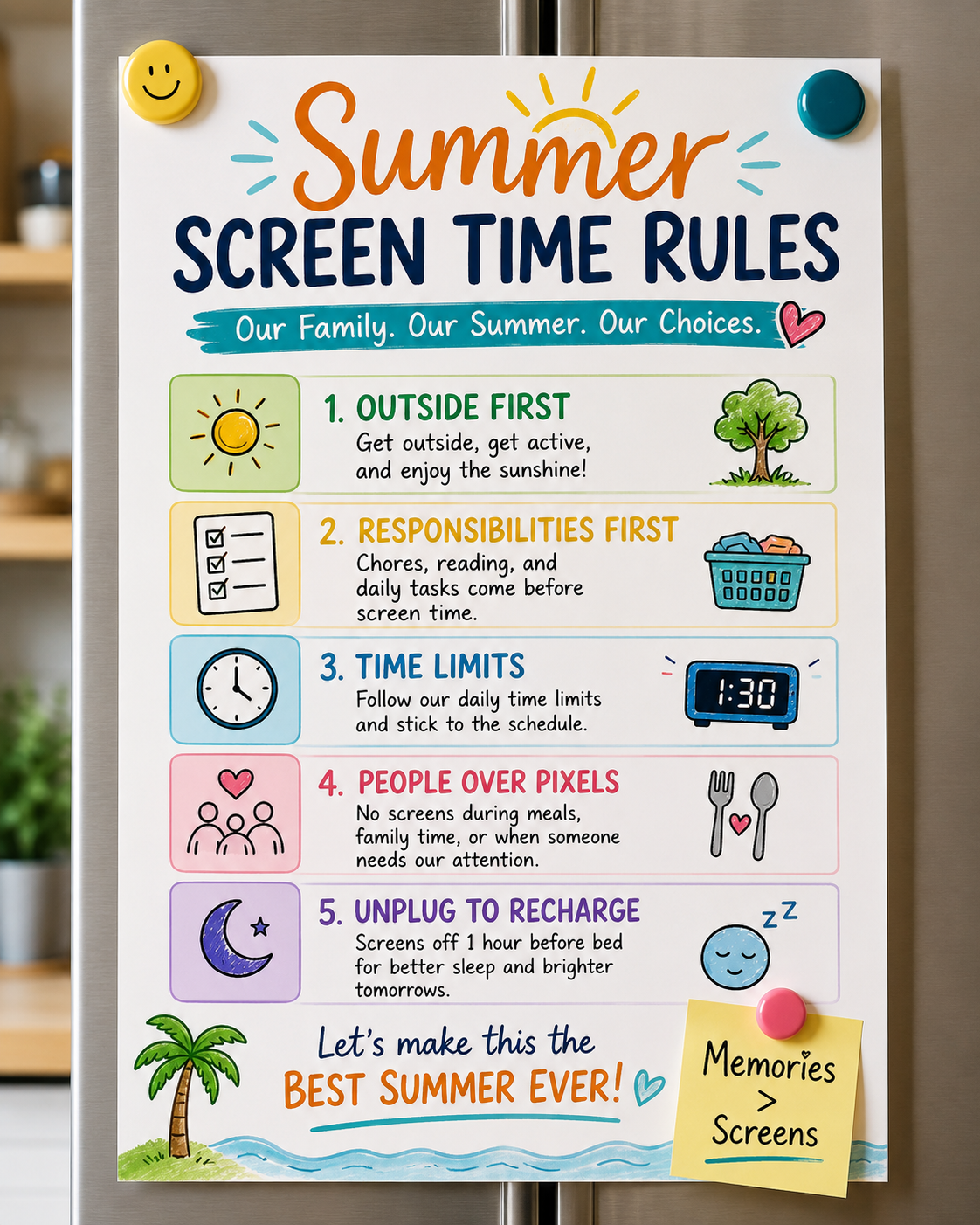
The AAP's recommendation for putting this into practice is a Family Media Plan — a written, family-specific set of rules that fits your actual household. Not a fantasy of what perfect parenting looks like. Your family, with your kids, adapted to your summer.
What This Looks Like By Age
The updated guidelines still recognize what child development research has always shown: what works for a 6-year-old doesn't work for a 15-year-old. Here's the framework by age band.
What Actually Works: The Practical Playbook
The old rule was easier to enforce and easier to fail. The new one asks more of parents — but it actually works with real kids.
— Robert Hackenson Jr.Across every age band, the research points to a small set of moves that reliably help. Do these five and you're ahead of most families.
- Write down your family media plan. The AAP has a free tool for this at HealthyChildren.org. Actually write it. Post it on the fridge. Revisit it every few weeks over the summer.
- Protect the anchor moments. Meals, bedtime, wake-up. Even one device-free window per day — dinner is the easiest one — reshapes the tone of the whole household.
- Front-load summer with a rhythm. Boredom is not a screen-time problem to be solved. It's the setup for creativity, imagination, and independence.
- Model what you want to see. "Technoference" — parent distraction by phones — has been directly linked in JAMA research to worse mental health outcomes in children.
- Co-view and talk about content. For younger kids this is protective. For teens it's how you stay a trusted voice against algorithms and peer feeds.
Bring this conversation to your child's school this fall.
Dynamic Influence's social media safety programs meet students where they actually are — age-appropriate assemblies for elementary, middle, and high school audiences. If you're a parent who wants your school to reinforce what you're doing at home, this is the ask.
See Speaker Programs →The Part About You
There's one section of the updated AAP guidelines that most parenting articles skip because it's uncomfortable. So I'll be direct about it.
The single strongest predictor of a child's screen habits is a parent's screen habits.
Pediatric researchers have a name for it — technoference — and studies published in JAMA Network Open have linked parent phone distraction to worse mental health outcomes in adolescents. Not what your kids are doing on their phones. What you are doing on yours in front of them.
If you're implementing a family media plan this summer, the plan needs to include you. Not as an afterthought. As the anchor. This is the harder part. It's also the part where the leverage is highest.
One Speaker, Every Level
If your district is going to invest in social media safety programming this fall — and the Surgeon General's 2023 advisory is a strong case for doing exactly that — the coordinated approach is dramatically more effective than one isolated assembly.
Same speaker. Elementary, middle, and high school on the same day. Age-appropriate at each level. Evening parent night to close the loop.
One program. Every level. One day rate.
Through a flat day rate, a district can bring one experienced speaker to elementary, middle, and high school — up to four presentations in 24 hours, shared across schools and budgets, with an evening parent night.
See Flat Day Rate Pricing →The Bottom Line
The old rule was simple to state and easy to fail. The new one asks more of you as a parent. It asks you to think about content, not just quantity. Co-view when you can and model the behavior you want to see. Sit down as a family and write down a plan you'll actually stick to.
It works better because it's built for real families. The pediatric research is behind it. Your job is to do the harder version — and to do it starting today, not in September when the school-year structure comes back.
Have the family plan meeting this weekend. Not next.
Revisit as a family every 4-6 weeks. Adjust as needed. Every check-mark is a win.
- We have a written Family Media Plan every family member has agreed to
- Devices stay out of bedrooms at night
- At least one meal per day is device-free (parents included)
- I know what content and apps my kids are using
- We co-view or discuss media together at least a few times a week
- My kids see me practicing the same rules I'm asking of them
- We revisit and adjust the plan every 4-6 weeks
- I'm having conversations, not just enforcing rules
Frequently Asked Questions
Marked up as FAQ schema — targets voice search & AI answer engines.
How many hours of screen time should kids have during the summer?
The American Academy of Pediatrics no longer recommends a specific daily time limit for most children over age 5. Their updated approach focuses on quality of content, context of use, and whether screen time is displacing sleep, physical activity, and family time. For children under 2, they recommend no screen time except video chats. For ages 2-5, one hour a day of high-quality content.
What is a Family Media Plan?
A Family Media Plan is the AAP's recommended approach to setting screen time expectations. It's a written, family-specific set of agreements about when, where, and how screens are used. The AAP hosts a free tool for creating one at HealthyChildren.org.
How much social media is too much for teens?
The U.S. Surgeon General's 2023 advisory found that adolescents using social media more than three hours a day face double the risk of mental health problems compared to peers who use less. Nearly a third of teens report using social media "almost constantly."
When should I let my child have their first phone or social media account?
This is a personal family decision, but pediatric guidance increasingly supports delaying both. Many parenting movements now recommend waiting until at least 8th grade for a smartphone and delaying social media use until age 14 or later.
Are educational apps and video calls counted the same as scrolling social media?
No. The AAP's updated 2024 and 2026 policy statements specifically distinguish between different types of screen use. Creative, educational, and connection-based use is treated differently than passive scrolling on algorithm-driven feeds.
Sources
publications.aap.org
publications.aap.org
healthychildren.org
hhs.gov/surgeongeneral
commonsensemedia.org
ncbi.nlm.nih.gov