
Seeing Through the Vapor
Everything from the keynote, in one place — the takeaway packet, the full session recording, and a thank-you for the people who spent the day doing this work.
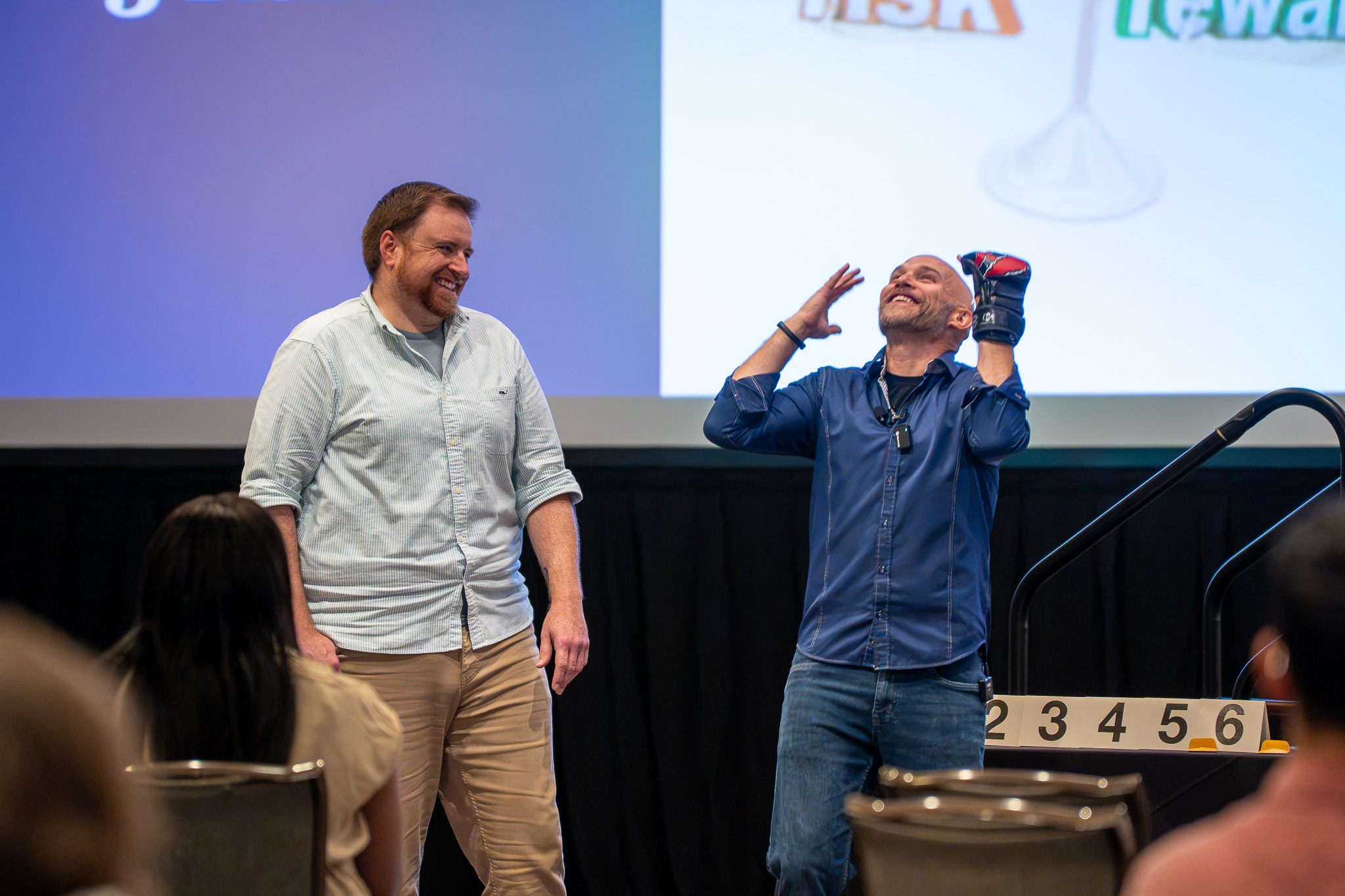
Thanks for a genuinely great room. You raised your hands, you volunteered, and you laughed at the right parts — which, in a session about youth tobacco and vaping, is not a given.
I promised I’d put the resources somewhere you could find them. This is that page. Nothing here requires a login, a form, or your email address. Take what’s useful.
The Takeaway Packet
Five pages. Every statistic checked against its primary source.
This isn’t a recap of my slides. It’s the working version — the frameworks, the specific language, and the verified facts, written so you can use them Monday without having to reconstruct the session from memory.
- Build Your Life — the decision framework, and why “make good choices” has never once changed a teenager’s behavior
- The Three Rules of a Smart Decision — the teachable structure from the coin-flip demonstration
- What’s actually in it — a verified-claims table you can put in front of a skeptical student, worded to survive being fact-checked on a phone
- The industry playbook — documented, quotable history from 1946 to 2023, for making young people feel played rather than warned
- Refusal scripts — actual sentences, short enough to use under pressure
- The stress reframe and the poker frame — for the conversations that aren’t really about vaping
- The chapter blueprint — the non-user group model that grew from 13 members to over 225
- Full source list — every claim cited, so you can bring this into a CE-relevant setting without hedging
A few numbers that circulate widely in this field don’t survive checking. The packet flags three of them, and explains what to say instead. If you’ve been using the “87% relapse in the first week” statistic, that section is worth two minutes of your time.
Watch the Full Session
For the parts you want to see again — or the colleague who couldn’t be there.
The complete keynote, recorded live in Birmingham. Useful if you want to bring a demonstration into your own programming, share it with a team that couldn’t attend, or just see the poker chip routine one more time to figure out how it worked.
Fair warning: it does not work the second time either.
Start a Non-User Group
The model I talked about on stage, with everything you’d need to run it.
When I was in high school I went to a wellness conference, and I remember standing near a group of students talking about how they were going to go party and drink that weekend. A few of us walked away deflated. It seemed like everybody was using — so what was the point of fighting it?
Our advisor, the school counselor, told us the statistics said otherwise. The majority of kids don’t use. Most of them are already making smart decisions. The problem is that we don’t see them and we don’t hear about them. And the kids who were making those decisions weren’t being rewarded for it. Where was their incentive?
So she challenged us to do something about it, and we started the non-user group — the N.U. Group. We raised money and used it to fund fun activities. We kept it small the first year, about 13 kids. The next year we opened up membership, still limited, 50 kids.
The goal was never to preach about not doing drugs. It was to lead by example, show other kids that we didn’t use, and make the activities good enough that membership was something you wanted — a reward for making smart decisions.
If you want to start one, both documents below are yours. No form, no email — same as everything else on this page. If you get one running, I’d genuinely like to hear about it.
Start a Non-User Group Toolkit
How the group was built and run — recruiting, keeping membership limited on purpose, fundraising, and choosing activities kids actually want to be part of.
Download the toolkit ↓
Non-User Group Templates
Fill-in templates you can edit and put your school’s name on — no need to build the paperwork from scratch.
Download the templates ↓
10% Off — For Everyone Who Was in the Room
Through October 31, 2026
You spent a full day on this. That deserves more than a handshake.
Through October 31, 2026, anyone who attended the summit gets 10% off anything I offer. There’s no code to enter and nothing to keep track of — just mention the VitAL summit when you reach out, and I’ll apply it.
Speaking Presentations
K–12 assemblies, parent education nights, staff development, and conference keynotes. Bullying and cyberbullying, social media safety, vaping and substance awareness, mental wellness, and resilience.
Vaping Redemption
An online course for students caught vaping — an alternative to a suspension that produces nothing. Video modules, required reading, section quizzes, a printable study guide, and a personalized certificate of completion.
WellHubs
A customized wellness hub built around your school — your policies, your local referral pathways, your community’s resources. Students and parents get answers at the moment they need them instead of a folder nobody opens.
Custom Programming
Multi-session series, district-wide rollouts, and train-the-trainer work. If you have something specific in mind, ask.
Applies to new bookings and purchases initiated on or before October 31, 2026. Just mention the VitAL Summit.
Tell Me What You’re Working On
Whether it’s a booking, a question about the course, or you just want to think out loud about a problem at your school — write to me here. I read these myself.
If you attended the summit, say so and the 10% applies.
One More Thing
Harvard’s Center on the Developing Child, after decades of resilience research, found that the single most common factor among children who do well despite serious hardship is
at least one stable and committed relationship with a supportive adult.
Not a program. Not a curriculum. One adult.
Everyone in that room already holds that job. Thanks for doing it.
Leave a Reply